Usseewa Ado Meaning: The Slang Title Hides Six Stacked Kanji That Say Mediocre Twice in the Same Breath
The title うっせぇわ is street slang. But the chorus drops a six-kanji wall, 一切合切凡庸, that pounds the word mediocre into the listener twice. Here is what is happening.
Usseewa Ado Meaning: The Slang Title Hides Six Stacked Kanji That Say Mediocre Twice in the Same Breath
Ado was seventeen when she recorded うっせぇわ. The song landed one day before her eighteenth birthday and ran past the rest of J-pop before most people knew her name. You probably know it from short clips, from the chorus people scream along to at karaoke, or from parents complaining their kids were repeating it at home.
The title is the bit everyone remembers. うっせぇわ. Not うるさい. The slangy contraction of "shut up," with the casual わ on the end, three syllables of pure exhaustion.
But the loudest moment in the song is not in slang.
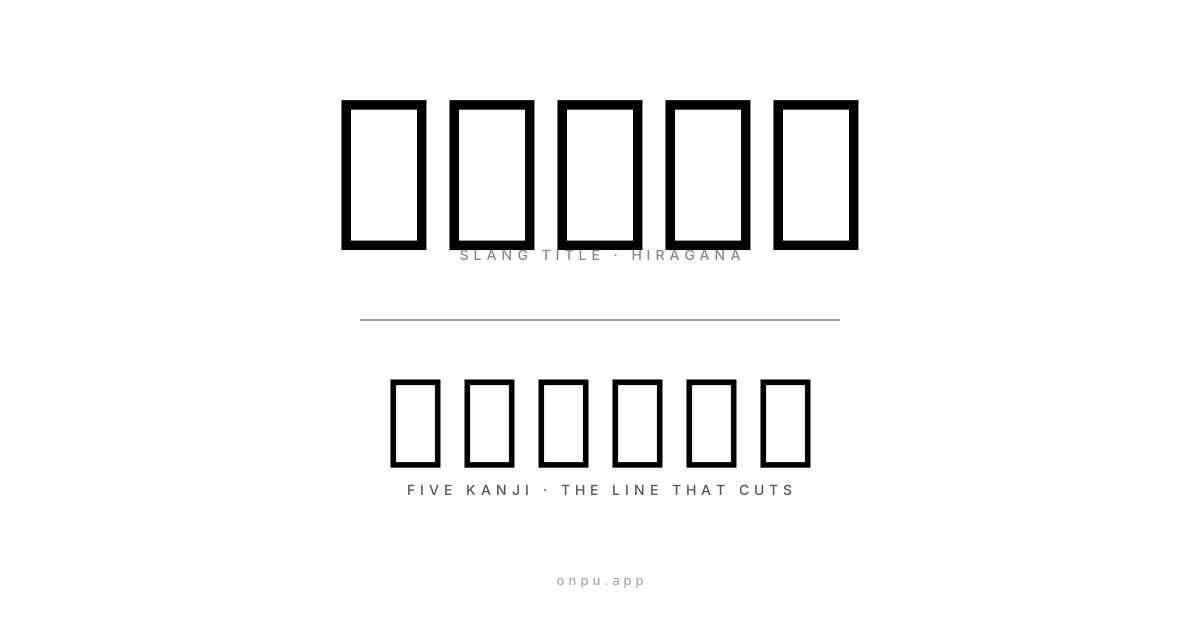
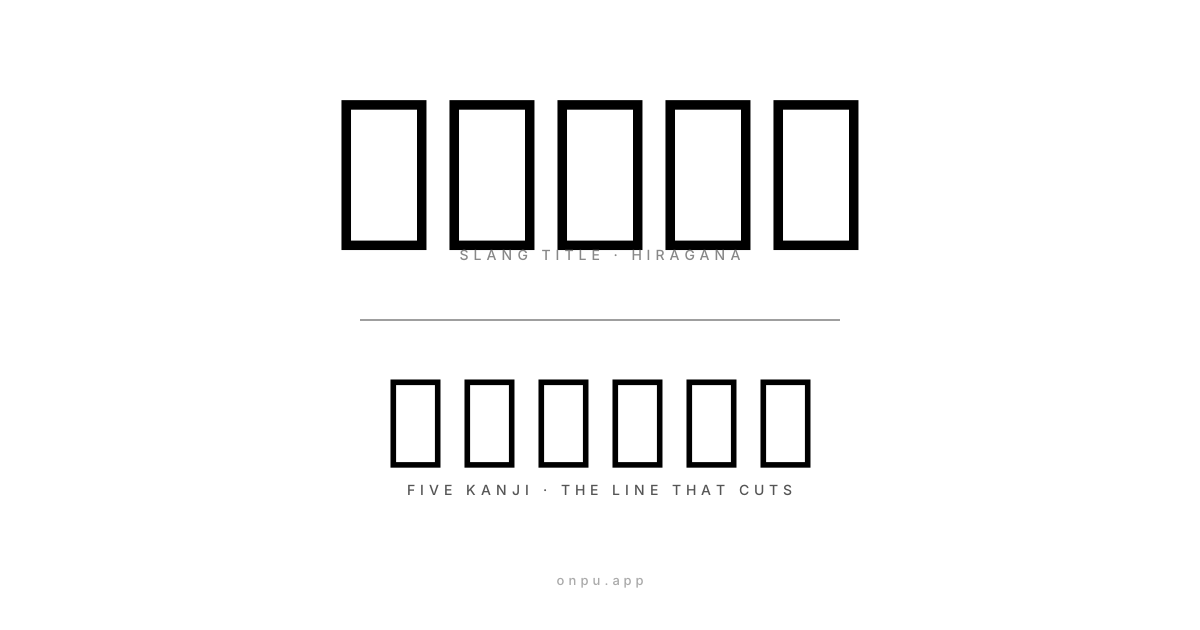
It is a six-kanji wall, 一切合切凡庸, that sits in the chorus and stacks the word "mediocre" onto the word "everything" with no breathing room.
That's where the song landed for me, not the title.
In this post, you'll learn:
- Why うっせぇわ exists as hiragana but the cutting line lives in kanji
- The six-kanji line in the chorus and what each character is doing
- How 凡 and 庸 are two different kanji that both mean "mediocre"
- Why this script switch is what makes the song cut harder than its slang siblings
5 min read
The title is hiragana for a reason
うっせぇわ is the colloquial form of うるさい (annoying, noisy) plus the final particle わ. Both pieces are casual. Neither is written in kanji even though うるさい has perfectly good kanji forms, 煩い and 五月蝿い, that get used in literary writing.
Choosing hiragana for a word that has a kanji form is a choice. Hiragana floats past the eye. It feels phonetic, lived-in, the way a teenager would actually write a text. Kanji slows the reader down. Each character takes a beat to land.
So the title is light. うっせぇわ reads like something a tired seventeen-year-old mutters into a notebook. It is not declaring war.
That makes the chorus's switch into kanji land harder.
The line nobody catches in translation
Here is the chorus block, with the line in question bolded:
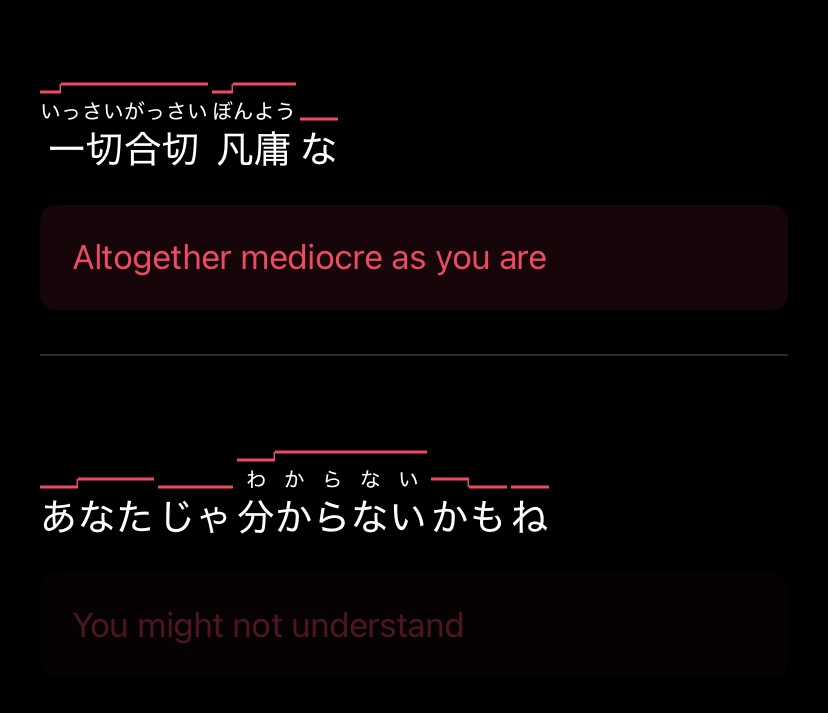
あなたが思うより健康です
一切合切凡庸な
あなたじゃ分からないかもね
Most English translations smooth this into something like "healthier than you think / utterly mediocre / someone like you wouldn't get it." That is accurate. But it loses what is happening on the page.
一切合切凡庸 is six kanji in a row. No hiragana between them. No breathing room.
In a song where almost every line carries a hiragana wash, this six-kanji block is a wall. Visually it sits there in the lyric sheet like a stamp. Read aloud, the consonant cluster issai-gassai-bonyou refuses to slur. Each kanji forces you to land on it.
What each kanji is actually doing
Pull this apart and the move gets clearer.
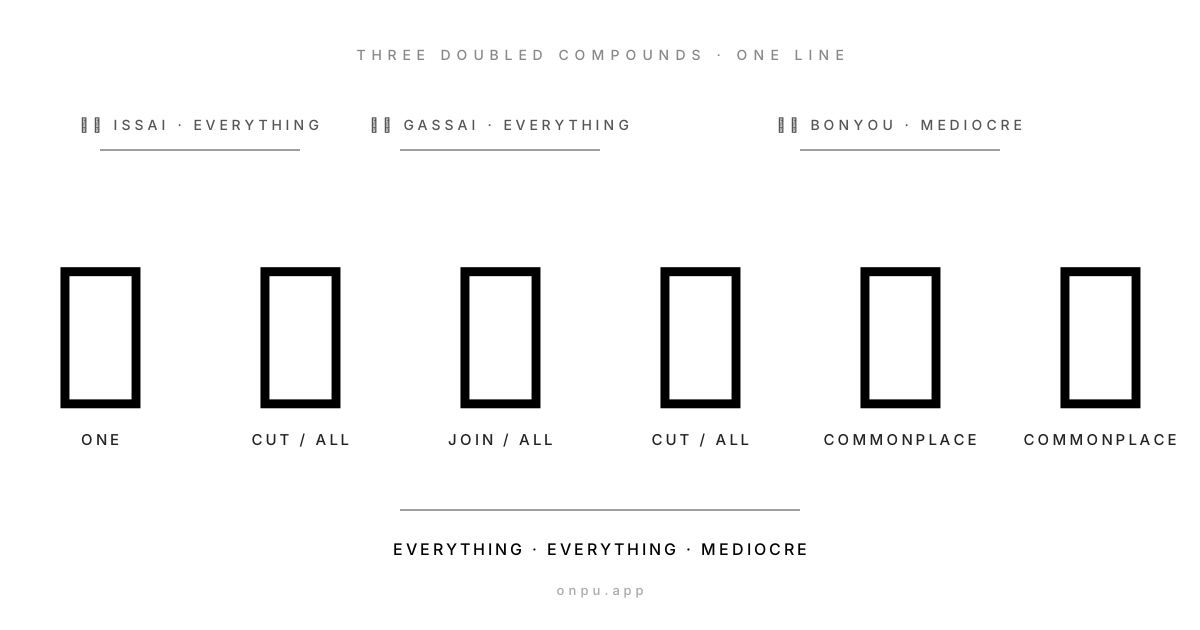
一切 (issai) is a fixed compound that means "everything, all, the whole thing." 一 is "one." 切, which usually means "cut," takes a sense of "all, entire" inside this compound. Old loan from classical Chinese.
合切 (gassai) also means "everything, lock-stock-and-barrel." Different sounds, same meaning. Together, 一切合切 (issaigassai) is one of those Japanese reduplicating compounds where you say the same thing twice for emphasis. The English equivalent is something like "every single solitary thing." It already means "everything" by itself. Saying it twice is the move.
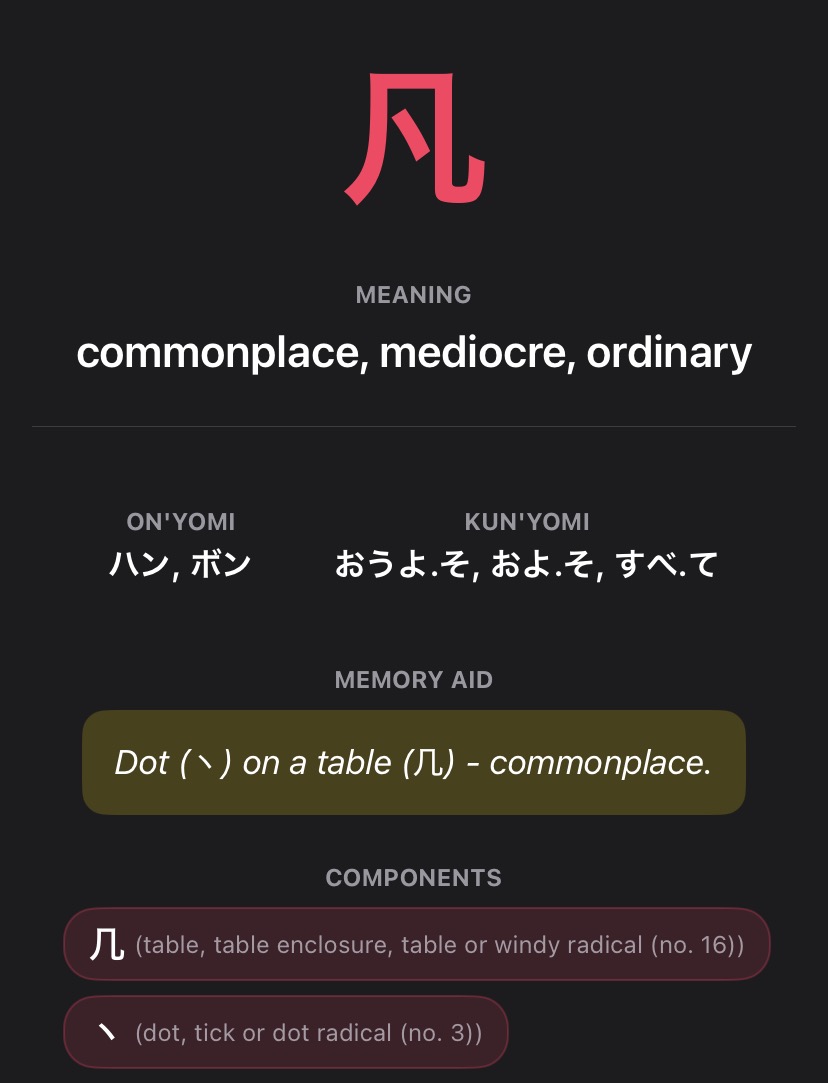
Then 凡庸 (bonyou) is "mediocre, commonplace, ordinary." 凡 means commonplace. 庸 also means commonplace. According to Onpu's kanji data, 凡 breaks down as a single dot on a table, and 庸 as a worker under a cliff. Two separate visual metaphors for "boring everyday thing," fused into one word.
So she is not just calling someone "mediocre." She is saying everything-everything-mediocre-mediocre. The line is doing the same trick twice in a row. Reduplicating "all," reduplicating "mediocre," and slamming them together.
This is the same kanji-as-emphasis impulse Kyouran Hey Kids leans on by repeating the title kanji at the start of every chorus line. Old trick. The execution here is just particularly compressed.
凡 and 庸 are not the same kanji. They mean the same thing on purpose.
This is the part that took me a while.
If you want to call someone mediocre in Japanese, there are shorter ways. 普通 (futsuu, ordinary). つまらない (boring). 平凡 (heibon, plain and ordinary). All of them work. None of them get used in this line.
Instead, the song reaches for 凡庸, the compound where you take the kanji that means commonplace, and you put it next to the other kanji that means commonplace.
凡 is a dot sitting on a table. The mnemonic in the data is exactly that, 丶 (dot) + 几 (table). One nothing on a flat surface.
庸 is a worker under a cliff. 广 (cliff radical) over a worker shape. Common labor, common life.
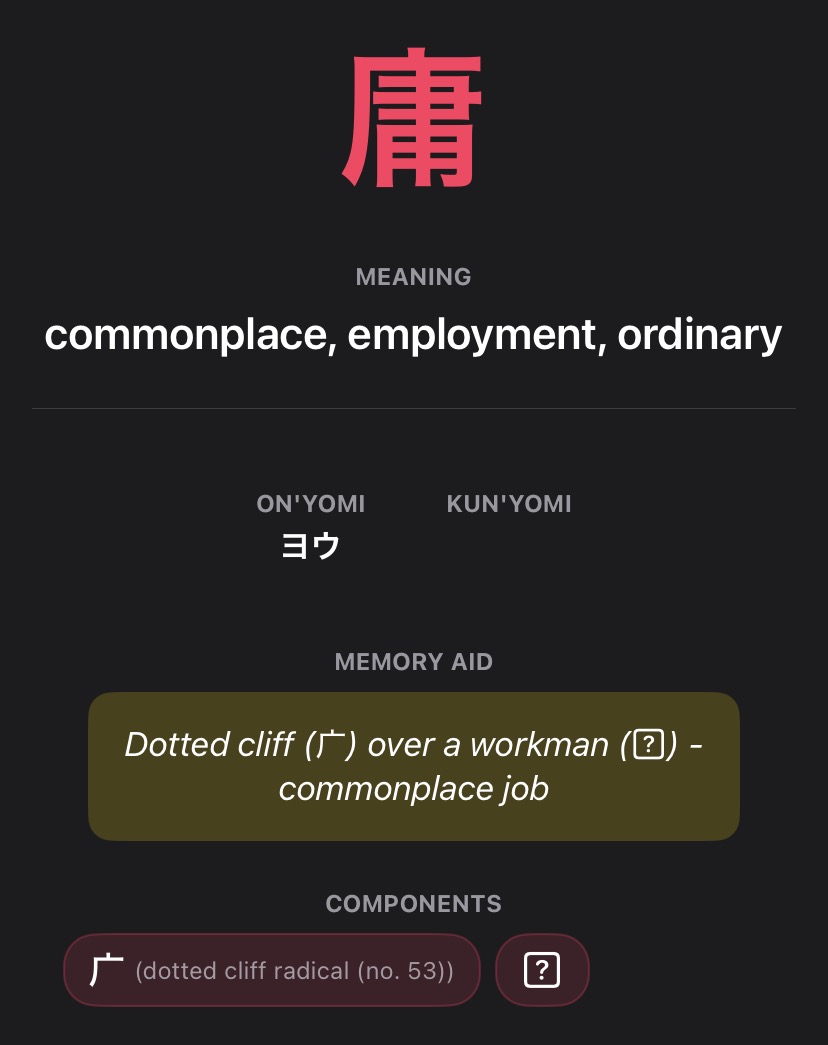
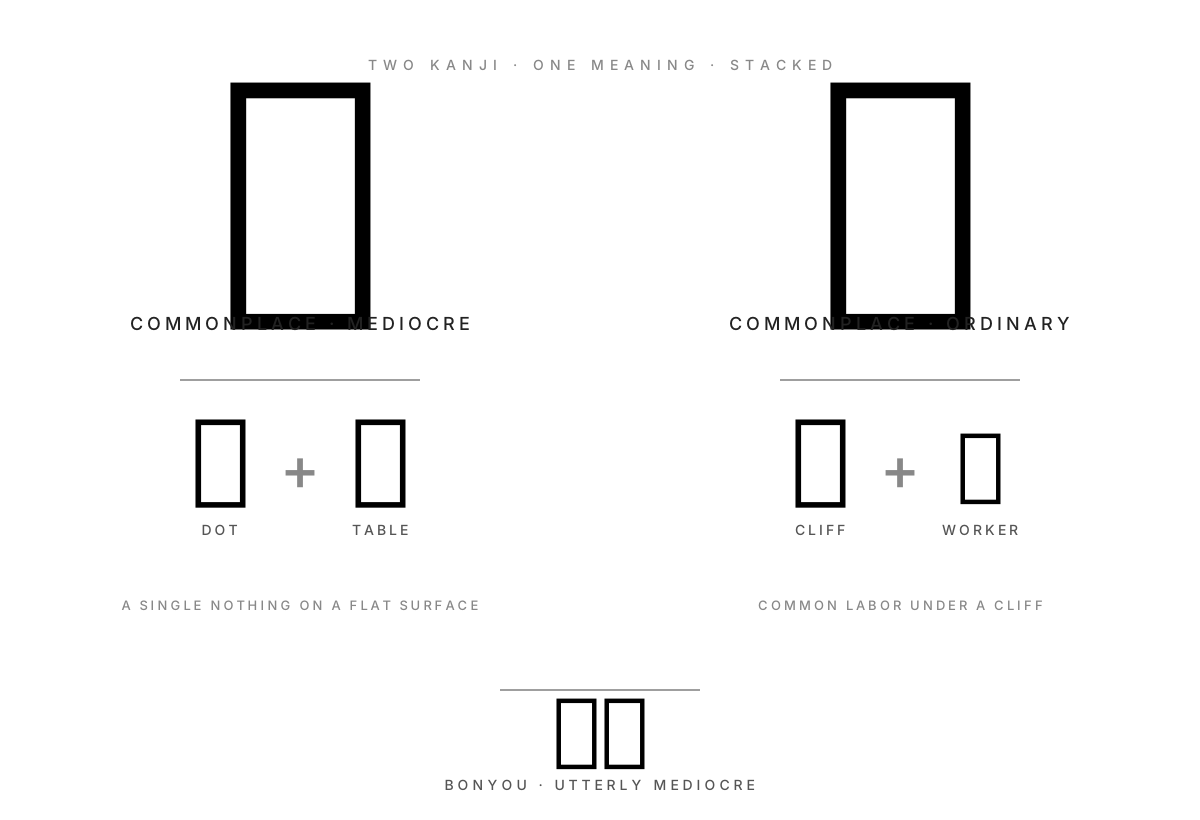
Both characters reach for the same idea, plainness, through different images. The compound 凡庸 is two metaphors for ordinariness sitting back to back, doubling down on the insult.
This is the move that doesn't survive translation. "Utterly mediocre" gives you the gist. It does not give you the shape of the kanji block on the page or the doubled metaphor working underneath. You can only see this in the kanji.
The closest thing in another song I've written about is the way Lemon uses 苦 to mean both bitter and suffering in the same chorus. Different mechanic, same kanji doing two jobs versus two different kanji doing the same job, but the same impulse: let the script carry meaning English can't.
The script switch is what makes the line cut
Step back and look at how this works structurally. The title is hiragana, slangy, short. Most of the verses carry a normal density of kanji and kana mixed. Then the chorus drops this six-kanji wall.
The contrast is the punch. If she had written the line as ぜんぶ つまらない あなたじゃ分からないかもね, in mostly hiragana, it would mean roughly the same thing and read flat. It would sound like an eye-roll. With 一切合切凡庸 in dense kanji, it reads like a verdict. Six characters that do not flinch.
The song is a teenage rant on the surface. Underneath, the kanji are doing classical poetry's job, packing meaning into a tight visual block and making the reader slow down to absorb it. Itte by Yorushika does a quieter register switch where one homophone kanji change turns a love song into a funeral. Different switch, same trick of using script to carry weight English needs full sentences for.
Once you start watching for the script density, you start spotting the move in a lot of Japanese songwriting. Hiragana for the easy stuff. Kanji for the line that's actually doing the work.
Closing
I had heard うっせぇわ a hundred times before I actually looked at the lyric sheet. The slangy title and the screamed chorus had me hearing it as just an angry song.
What I had been missing was that the angriest line is not screamed. It's written in six dense kanji that almost nobody reads carefully when they are singing along. 一切合切凡庸. Everything, everything, mediocre, mediocre. The song is doing classical Japanese reduplication while wearing a hiragana hoodie.
If you also listen to Ado, paste うっせぇわ into Onpu and tap each of the six kanji in 一切合切凡庸. The components are right there. Two different ways to draw "ordinary" sitting next to two different ways to say "everything." I would love to know what else I'm missing in this song.