Kyouran Hey Kids Meaning: Why Every Chorus Line Starts With the Same Kanji as the Title
Noragami ARAGOTO's opening 狂乱 Hey Kids hammers one kanji into a mantra. 狂 is dog plus king, and every chorus line starts with it.
Kyouran Hey Kids Meaning: Why Every Chorus Line Starts With the Same Kanji as the Title
Noragami ARAGOTO's opening is one of those tracks the algorithm keeps sliding into your anime AMV playlist. You know the riff. You know the shape of the chorus. You've probably muttered "hey kids" under your breath at 2am, looking for a snack, for reasons you can't fully explain.
I sang along to this thing for years before I actually looked at the lyrics.
Here is the thing I missed:
Every chorus line starts with the same kanji that is sitting in the title.
Not the same word. The same kanji, stripped down to one character, reshaped into a verb, and pounded at you six times in a row.
Once you see it, the song is a different song.
In this post, you'll learn:
- Why the title 狂乱 is two different flavours of chaos stacked together
- What 狂 looks like up close (it is a king wearing the dog radical)
- The grammar trick the chorus pulls on its own title
- One reason the kanji rhymes with a show about stray gods
5 min read.

The title is two different flavours of chaos
The full Japanese title is 狂乱 Hey Kids!!, pronounced "kyouran hey kids." 狂乱 is one word made of two kanji, and they are not saying the same thing.
狂 is listed in kanji-data.json as N1, meaning "confuse, crazy, insane." It's the personal kind of chaos. One person, losing it.
乱 is N2, meaning "disorder, disturb, riot." It's the collective kind. A crowd coming undone. A system unravelling.
Stack them together and you get 狂乱: someone going feral while the whole room catches fire. Internal meltdown and external meltdown, in one word — the same way パラリラ plays with sound over meaning, where the title is doing mood work before you've parsed a single syllable.
English picks one and runs. "Frenzy" is close, but "frenzy" is mostly about the person. "Riot" is mostly about the crowd. Japanese puts both in the same compound and lets you feel the overlap.
If you have the song running in your head right now, try listening for the title during the chorus. It shows up exactly twice in the full version, at the top of each chorus. Everywhere else, the song uses only half of it.
狂 is a king wearing the dog radical
I paste pretty much every rock song I love into Onpu at some point, usually at a coffee shop, usually while pretending to work. When I pulled up this one, I tapped the kanji 狂 out of curiosity.
Here is what came back.

狂 is made of two parts.
On the left is 犭. That is the dog radical, the leaning version of 犬 (dog). It shows up as the signature move in a bunch of animal characters. 狼 (wolf). 猫 (cat). 猿 (monkey, which I cannot decompose here because I haven't verified the components, but the dog radical is right there).
On the right is 王. King. Sovereign. Rule.
Put them side by side and you have a king with the dog radical attached to him. Royalty that has gone animal. A monarch who has lost his crown under his own claws.
I want to be careful here. This is a visual reading of the modern kanji, not an etymology lecture. The actual historical origin of 狂 is debated among scholars, and I don't trust myself to mediate that debate. What I can say is that when you put 犭 next to 王 on a screen and stare at it, you get an image. The image fits the word.
The move here is general: next time a kanji starts with the dog radical, the dog is usually doing mood work. Subject is on the right. Emotional temperature is on the left. It is a pattern you can use on 狼, 猫, 狂, and a handful of others once you are looking for it.
The chorus turns the title into a verb
Here is the part that did it for me.
The title 狂乱 is a noun. Two kanji. A thing. A state.
The chorus strips one kanji off and uses it on its own, with a 〜って ending, which in this context acts like a soft imperative or a linking verb form. It becomes 狂って (kurutte). "Go mad and..." The state has become an action. A command.
Now look at the chorus:
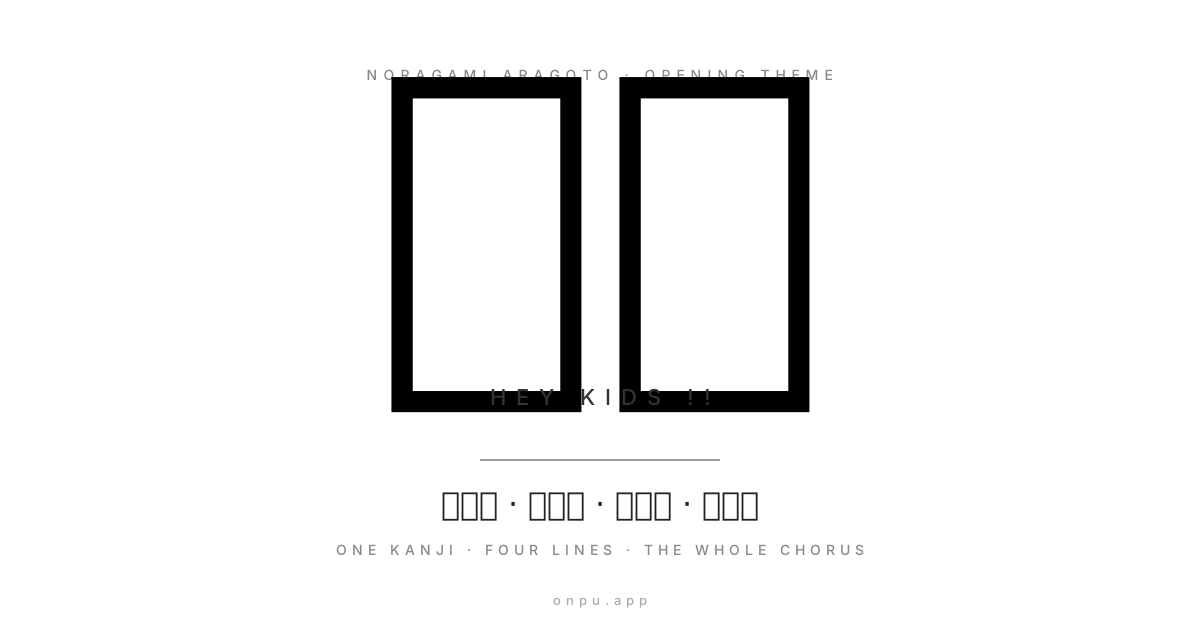
狂って hey kids! 次第に時代は変わって 終わらない焦燥 Kurutte hey kids! Shidai ni jidai wa kawatte, owaranai shousou. Go mad, hey kids. Little by little the era keeps shifting. Restlessness that won't end.
狂って hey kids! 出会うはずだったあなたと wow Kurutte hey kids! Deau hazu datta anata to, wow. Go mad, hey kids. With the you I was supposed to meet.
狂って泣いた 忘れない 愛を探して 繋ぎたいずっと Kurutte naita, wasurenai. Ai wo sagashite, tsunagitai zutto. Went mad and cried. I will not forget. Searching for love, wanting to stay connected.
狂って hey kids! それでも未来は儚いか? Kurutte hey kids! Soredemo mirai wa hakanai ka? Go mad, hey kids. Even so, is the future still fragile?
Four lines. All starting with 狂って. The same single kanji that lives inside the title, now the first beat of every phrase.

This is the trick. 狂乱 (the noun) is the thing we are inside. 狂って (the verb) is the thing the song keeps telling you to do. One is the weather. The other is your homework.
This is also the exact move Hai Yorokonde pulls — bright surface, devastating underneath — the riff sounds like a rallying cry, and then you read "restlessness that won't end" and "is the future still fragile?" Compare it to how this would land in English. Imagine a pop chorus that opened four straight lines with the word "frenzied." You would get tired of it in one chorus. In Japanese, 狂って works because the verb form creates rhythm and expectation, the way "gonna" or "let's" carries choruses in English rock. Same kanji, different jobs, no fatigue.
Next time you are listening to a Japanese rock song and a title word turns into a verb halfway through, you will see this same move. Compound noun in the title, root kanji pulled out and used as a verb in the chorus. It is a staple of the genre.
The song and the show rhyme, and I don't think it was an accident
I have no source that says Takuya Yamanaka, the band's vocalist and the song's composer, picked 狂乱 because of anything in Noragami. I don't want to invent motivation for him.
But I cannot look at this combination without smiling.
Noragami is, at its foundation, a show about stray gods. The Japanese title is ノラガミ, which pairs ノラ (stray, as in a stray animal) with 神 (god). Divine beings who fell out of heaven's chain of command and are now roaming. Yato, the protagonist, is one of them. Broke. Unknown. Fighting his own forgotten identity.
Now look at 狂 again: 犭 + 王. Dog radical plus king. A sovereign wearing the animal marker. Royalty that has gone stray.
Same idea, in two different alphabets.
Maybe Yamanaka did notice this and liked it. Maybe the production team suggested the kanji for the title because it fits the mood. Maybe it is pure coincidence and I'm pattern-matching in the coffee shop. I do not know, and I am not going to pretend I do.
What I know is that once I saw it, I could not unsee it. And that every time the chorus hits 狂って, I hear a sovereign, gone feral, starting a line.
What to do with this next time the opening plays
If Noragami is somewhere on your list, or you have been rewatching ARAGOTO for the tenth time, paste 狂乱 Hey Kids!! into Onpu and let the chorus roll. Watch how many times 狂 shows up in one minute of lyric. Tap it once and look at the decomposition. Look at the kanji next to it in the title.
I would love to know if there are other anime openings that do this, where a title kanji becomes the verb the chorus keeps commanding. I am sure there are — 廻廻奇譚 front-loads its own title energy in a similar way. Kyouran is the one I noticed first, because it was the one I had been half-listening to for the longest.
Send me the ones you find.