Hai Yorokonde Meaning: There Is a Literal SOS Inside Japan's Biggest 2024 Song
Kocchi no Kento's はいよろこんで hides a literal SOS Morse code inside a cheerful chorus. Here is what the lyrics, the title, and the kanji for joy actually say.
Hai Yorokonde Meaning: There Is a Literal SOS Inside Japan's Biggest 2024 Song
If you have been on TikTok, a playlist, or near a Japanese high-schooler in the last year, you have heard Hai Yorokonde. The chorus is almost aggressively cheerful. The title is the kind of thing a convenience-store clerk chirps when you ask for a receipt.
So I spent a while thinking it was Japan's version of a "yes sir, right away" customer-service banger. Then I read the lyrics.
Buried inside that chorus is a literal SOS. Not as metaphor. As Morse code.
This post will take you 4 minutes to read and you will leave knowing:
- Why はいよろこんで is a specific kind of Japanese politeness, not just "yes"
- Where the SOS is actually sitting in the song (it is not hidden, it is typeset in the lyrics)
- What ギリギリダンス means, and why every English version softens it
- The one lyric line that tells you what the narrator is really doing
- Why the kanji 喜 (joy) shows you a mouth and a drum
Let us get into it.
The title is a service phrase, and that matters
「はい、喜んで」 is what a waiter says when you ask for extra ice. It is what a call-center rep says before putting you on hold. It is trained politeness in two syllables of real feeling and three of performance. Compliance smiling at you.
Kocchi no Kento, the artist, is Kento Sugao. He shared publicly in September 2023 that he lives with bipolar disorder. In interviews around the song's release, he has said he wrote はいよろこんで hoping people would build a daily habit of sending out an SOS.
That is a verifiable artist statement, not my fan theory. When you hear the title, the frame the artist himself has set is: this song is about a person who is performing "yes, gladly" while actually needing rescue — and there are three more Japanese songs that do the same upbeat-surface, devastating-underneath trick.
Hold onto that. It shows up everywhere once you notice it.
There is an SOS typeset inside the chorus
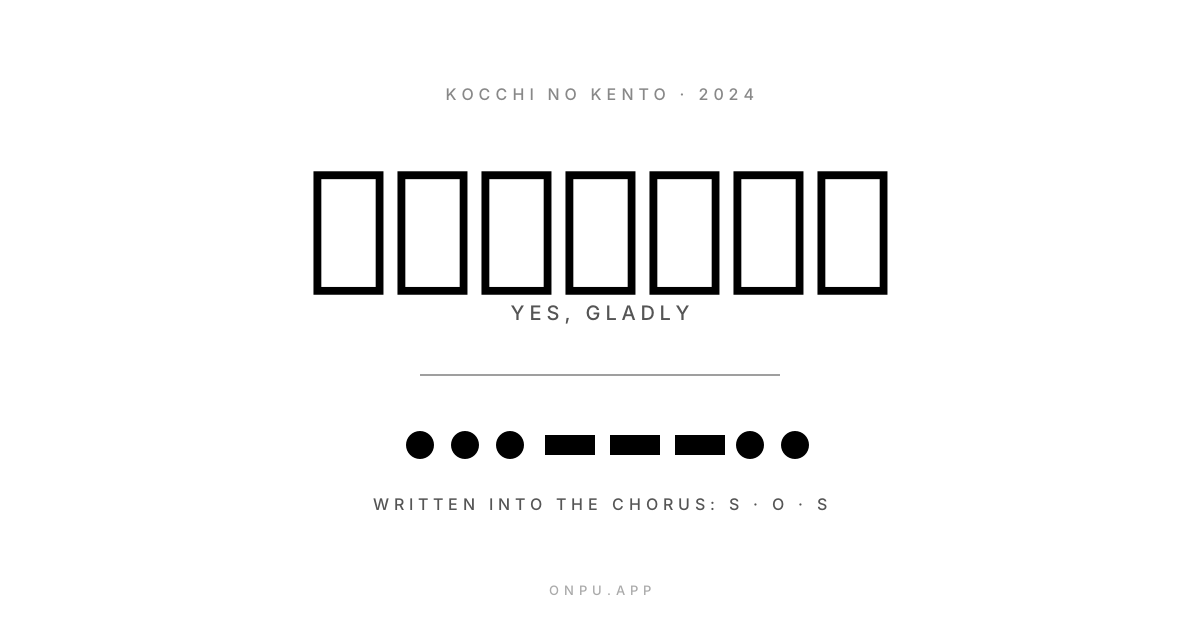
I want to be careful here, because songs get over-read all the time. This one is not over-read. Look at the official Japanese lyrics on any reputable transcript and you will see this line, repeated several times in the song:
・・・ーーー・・・
Three dots. Three dashes. Three dots.
That is international Morse code for SOS. It is not hinted at by the drum pattern, not being teased in the mix, and not living in some extended edition. It is written into the lyric sheet. You can see the dots and dashes typed out as characters, sitting right under the chorus.
The line directly before it says 鳴らせ君の3〜6マス, which is roughly "sound out your 3-to-6 squares." Three short beats, three long beats, three short beats. The narrator is naming the pattern just before the pattern arrives. Then the staccato hit in the track lands right where the dots and dashes sit in the lyrics.
Once you see it, it is all you hear. The hook is not "this song is kinda sad actually." The hook is: the song contains a distress signal, typed in, on the page.

ギリギリダンス is not "get it, get it done"
The other line you hear on loop is ギリギリダンス. Official English lyric cards translate it as "Get it, get it done." Catchy. Very singable. It also throws out the actual Japanese meaning.
ギリギリ is a word worth adding to your vocabulary if you do not have it yet. It is the word you reach for when you made the last train by two seconds. When the deadline is today at five and you finished at four-fifty. When you are barely passing. Barely awake. Barely making it.
So ギリギリダンス is "dance at the edge." Dance because if you stop dancing, you drop.
And the refrain wraps it in "踊れ" (dance) and "もっと鳴らせ" (ring out more). Which, once you know the Morse pattern is already in the song, reads as: keep dancing, and keep sending the signal. Do not stop doing either.
The English "get it, get it done" is not wrong exactly. It is just a completely different song. The Japanese version is someone doing the polite dance on the outside while barely holding on inside. The English version is a productivity anthem.
Next time someone in a Japanese text tells you they are doing something ギリギリ, you now know they are telling you how close to the edge they are. Not a bad word to pick up.
The lyric that gives the whole song away
If I had to point at one line in the song that rewires everything for an English listener, it is this one:
嫌嫌で生き延びて
Official English renders it as "living on reluctantly." Accurate, but it softens the verbs.
生きる is the normal Japanese verb for "to live." This line does not use that verb. It uses 生き延びる. And 生き延びる is a very specific word: to survive, to barely make it through, to outlast something you were not certain you could outlast. It is the word used in war stories, illness stories, and the survivor's side of the news.
嫌嫌 (iyaiya) is the word for reluctance, doubled for emphasis. Hating-hating. Saying no-no while doing the thing anyway.
Put together, that is not "living on reluctantly." It is "surviving out of unwillingness." Continuing because continuing is what the polite ギリギリ dance requires, not because continuing feels good.
And then the song immediately goes back into the chorus. Polite yes, polite yes, polite yes. SOS. SOS. Dance at the edge.
It is a hell of a construction. The surface is a trained service phrase — which is also the Japanese emotion word for beautiful pain hiding in gentle songs. The substance is a person making it through another day on unwilling fuel, signaling for help in a code almost no non-Japanese listener is going to catch on first pass.
Why the kanji for "joy" makes it worse
Here is where the kanji quietly doubles down. I found this one and it changed how the song felt to me.
The kanji for "joy" is 喜. It decomposes into two parts:
- 壴, a drum on a stand
- 口, a mouth

So 喜 is, in its own body, joy made into noise. A drum and a mouth — another song where one kanji quietly does two emotional jobs at once. Joy that is being produced, out loud, for an audience. Not joy felt in private.
That is exactly the kind of joy はいよろこんで is about. The service-job "yes, gladly" is the drum and the mouth. It is performed joy. It is what the narrator is instructed to do, all the way up until the Morse code starts tapping out underneath.
The title written in all hiragana, はいよろこんで, keeps that kanji off the page on purpose. It reads softer. More approachable. A little childlike, even. But the drum is already inside the song, right where you would expect the kanji to be.
Japanese songwriters play with hiragana-versus-kanji choices all the time. This might be one of them. I cannot prove Kocchi no Kento made that call with the kanji in mind, so I will not pretend. But the two facts sit next to each other, and they rhyme.
What to listen for now
I am not going to pretend I have the definitive reading. はいよろこんで is a complicated song, and the people who speak Japanese natively are still arguing online about what specific lines mean. But these three things are not up for debate:
The SOS is sitting in the lyrics as text. The artist has publicly said he wrote the song hoping listeners would make sending out an SOS into a daily habit, which is a kinder thing than most viral songs ever try to do. And ギリギリダンス, in plain Japanese, is not a productivity phrase.
If you already love this song, here is one small experiment worth trying. Paste the chorus into Onpu. Look at 嫌嫌で生き延びて. Sit on 生き延びる for a second, let it settle, and then look at what 喜 breaks into.
If the song lands differently after that, I would love to know what shifted for you. It did for me.