Setsunai Meaning: The Japanese Word for Beautiful Pain (切ない)
Not sad. Not bittersweet. Setsunai is being cut open by something beautiful that's ending. One word, every J-pop song.
I've had this feeling a hundred times listening to Japanese music. This specific ache that shows up mid-song, somewhere between sadness and beauty, and I could never pin it down in English.
Turns out Japanese has had a word for it this whole time.
切ない. Setsunai.
And the moment I learned what it meant, I started hearing it everywhere.
In this post, you'll learn:
- What setsunai actually means (and why "bittersweet" doesn't cut it)
- How to recognize setsunai in songs you already know
- Why Japanese music hits a nerve that English lyrics miss
5 min read
What Setsunai Actually Means (And Why I Couldn't Find It in English)
I tried to explain this feeling to a friend once. "It's like... sad but also beautiful? But not nostalgic? Like you're losing something while it's still happening?"
She said "bittersweet." Close. But not it.
Then I found the kanji.
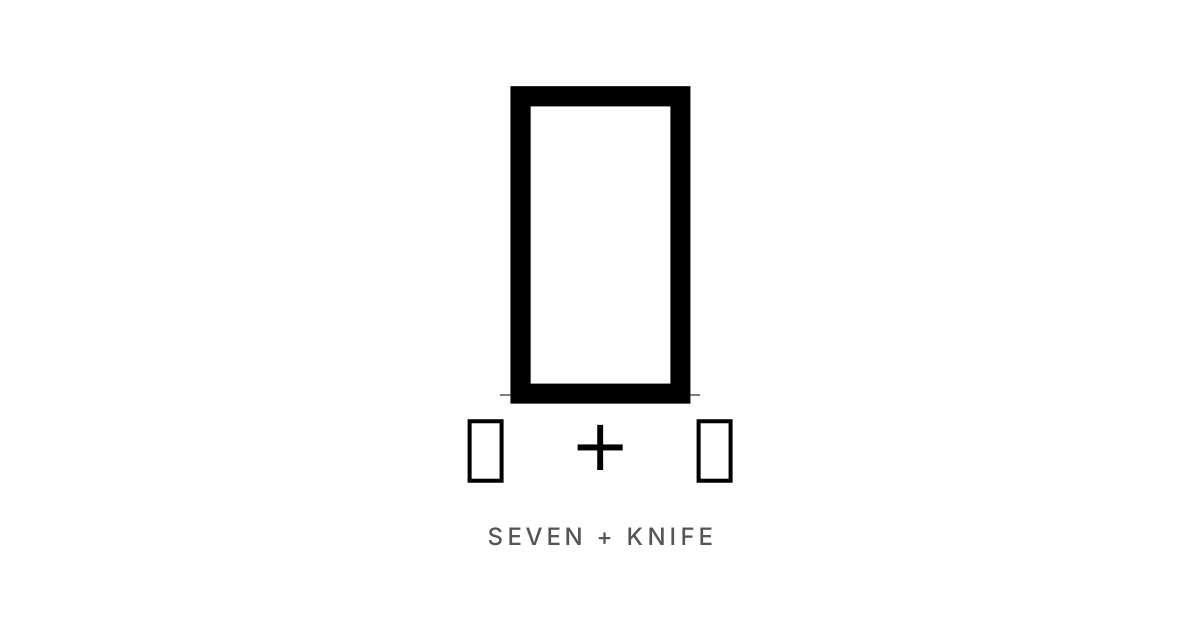
切 = 七 (seven) + 刀 (knife/sword). It literally means "cut."
Setsunai is the feeling of being cut open.
Not by something terrible. By something beautiful that's temporary. You're holding it, you know it's ending, and that knowledge is the knife. The present moment is already slipping away and you're grieving it in real time.
This is different from 悲しい (kanashii), which is just... sad. The loss already happened. You're looking back at it. And it's different from 懐かしい (natsukashii), nostalgia, where the pain has softened into warmth. You're smiling about something that's over.
Setsunai sits between them. You're still in the moment. It's still beautiful. And it's already leaving.
English needs a whole phrase to get close: "painfully beautiful," "achingly tender," "the ache of something fleeting." Japanese packs it into 切ない and moves on. I find that kind of amazing, honestly.
Here's the thing that got me: the moment you have a name for a feeling, you realize you've been having it all along. That tightness during a sunset that's disappearing too fast. A conversation you don't want to end. A song you wish wouldn't stop.
That's setsunai. You already knew it. You just didn't have the word.
Where I Started Hearing It Everywhere
Once I learned setsunai, it was like putting on glasses. Songs I'd been listening to for years suddenly had a label for what they were doing to me.
Lemon by Kenshi Yonezu was the first one that clicked. If you want to go deeper, I wrote about the full story of Lemon and the kanji 苦 at its center. It doesn't sound sad in the dramatic sense. It sounds clean, thoughtful, almost sparse. Then I found out he wrote it after his grandfather died. The lemon in the title isn't random. It's a sensory anchor, a smell, a taste, something that brings a specific person back who's gone. The sourness that cuts.
The entire song is setsunai without ever using the word. It's not screaming about loss. It's sitting with it. Quietly. That quiet part is what makes it setsunai instead of just kanashii. The grief isn't loud. It just... sits there.
Then there's 言って (Itte) by Yorushika, which has been on my playlist forever — I ended up writing about the 言って / 逝って homophone trick and two other songs that pulled the same move. 言って (itte) means "say it." But 逝って (itte) means "pass away." Same sound. Completely different kanji. The song asks: on your last day, will you regret the words you didn't say? You hear "say it" while feeling "pass away" underneath. The word itself is setsunai. You're speaking and dying in the same syllable.
And then, of all things, Baka Mitai from Yakuza. Yeah. The meme song. The deepfake one.
But if you actually read what 馬鹿みたい means: "I was such a fool." It's a woman looking back at lost love. She's not angry. She's not devastated. She's... tender about her own foolishness. Smiling at how stupid she was. That's setsunai. The beauty of recognizing your own mistakes from a distance, knowing you can't go back.
I genuinely did not expect a meme song to teach me a Japanese emotional concept, but here we are.
The pattern I keep noticing: setsunai songs don't rage. They sit with the feeling. The melody can be gentle or even upbeat. The ache lives in the words, in what's ending, in what you know you can't keep.
Why This Changed How I Listen to Japanese Music
There's a Japanese aesthetic concept called mono no aware (もののあわれ), roughly "the pathos of things." An awareness of impermanence. It's been part of Japanese art and poetry for centuries, and it runs through the music too.
English love songs tend to be direct about emotions. Adele tells you she's heartbroken. Sam Smith states the devastation. The feeling is named, declared, handed to you.
A lot of Japanese music does something different. The emotion isn't stated. It's embedded in the texture of the words, in the kanji, in homophones like 言って/逝って that only work in Japanese. You have to lean in to feel it. That's exactly what YOASOBI's Yoru ni Kakeru hides in its opening eight seconds.
This is probably why translations of Japanese songs always feel slightly off, at least in my experience. You can translate the words. But the setsunai evaporates somewhere between the languages. The weight of the kanji, the double meanings, the sounds that carry two feelings at once. That stuff doesn't survive translation.
It's also why I started wanting to read the actual Japanese instead of just English translations. Not because I'm trying to be some kind of purist. I just kept feeling like I was missing a layer. And I was. Setsunai was the layer.
When I paste lyrics into Onpu now, I look for 切ない or 切なさ. Sometimes it's right there in the text. But even when the word itself doesn't appear, the feeling usually does. That gentle ache, the beautiful thing ending, the seven knives in the kanji.
Setsunai isn't really vocabulary. It's more like a lens.
Once I started seeing it, every Japanese song I listened to felt a little different. More specific. Like I finally had the right word for something I'd been circling around for years.
If you also listen to Japanese music and you've felt that thing, that nameless ache, try looking for 切ない next time you're reading lyrics. Paste a song into Onpu and long-press 切 to see the knife inside the kanji. Seven and a sword.
You probably already know setsunai. Now you know what to call it.