Yoru ni Kakeru Meaning: What YOASOBI's Biggest Hit Is Actually About
YOASOBI's Yoru ni Kakeru sounds like a love song. It isn't. The real meaning, the novel it's based on, and why the catchy melody is the point.
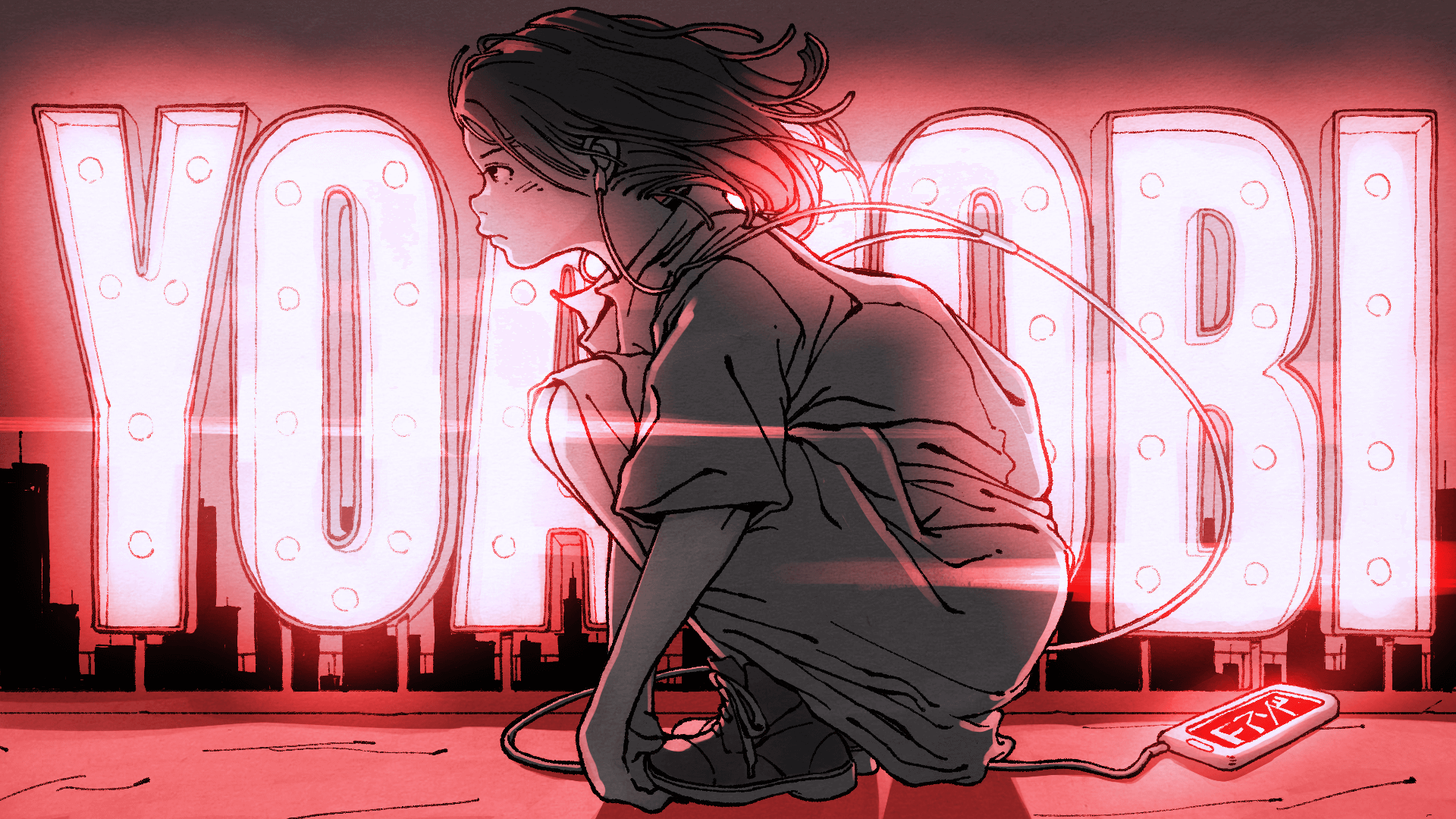
Yoru ni Kakeru is the first Japanese song a lot of people ever loop on repeat. Delicate melody, gorgeous drop. YOASOBI's 2019 debut, sitting in my rotation ever since.
I was about 200 listens deep before I actually looked at the first line.
Should have looked sooner. (I wrote a shorter version of this realization, along with two other songs that pulled the same trick on me, in 3 Japanese Songs You've Been Vibing To That Are Actually Devastating. This post is the deep dive on the YOASOBI one.)
The opening eight seconds of Yoru ni Kakeru are the thesis statement of the entire song. It's telling you exactly how it ends. In the prettiest voice you've ever heard.
In this post, you'll learn:
- What Yoru ni Kakeru is actually about (hint: death, disguised)
- Why the first line is a spoiler if you can read it
- The kanji in the title that changes the whole mood
- The novel YOASOBI turned into the song
- Why the producer made a song about death sound this catchy
6 min read
Yoru ni Kakeru Meaning: It's Not a Love Song
Here's the surface read most English listeners land on: dreamy night song, couple in love, pretty melody, vibes. That was my read for about a year. I genuinely thought the chorus was some kind of running-off-into-the-night-together moment. Something romantic.
The actual meaning is a lot darker than that.
Yoru ni Kakeru is about a man being seduced to his death by death itself, wearing the face of a woman he'd fall for.
I needed a beat when I first read that too.
The "night" the song gallops toward isn't evening, and it isn't a romantic escape. It's the other side of a ledge. The woman on the rooftop isn't his girlfriend in any ordinary sense. She's Thanatos, the Greek personification of death, appearing as the kind of person he'd be most helpless to refuse, so he'd follow her over.
YOASOBI's official English version softens the title to Into the Night. The Japanese is sharper. And the opening line gives the whole thing away before the first chorus even hits.
The First Line Is the Spoiler: Yoru ni Kakeru's Opening Lyrics
This is the part that made me sit with my phone for a minute and just stare.
The song opens with this:
| Japanese | Reading | English |
|---|---|---|
| 沈むように | shizumu you ni | like sinking |
| 溶けてゆくように | tokete yuku you ni | like melting away |
Sinking. Melting. Those are the first images the song hands you, before any narrative, before you've learned a single character's name. Not "the city is beautiful tonight." Not "I love you." Sinking. Melting.
For a long time I heard those as mood-setting. Pretty Japanese things you say about a night sky, the kind of softly poetic stuff that fills the top of any song. They do sound pretty. The voice floats.
But they aren't mood-setting. They're the thesis.
Once I knew the song was about someone falling off a building, the opening hit completely different. Sinking is what a body does. Melting is what a self does when it's giving up. The song opens with both sensations at once, and the rest of the track is just the story of how we got here.
The kanji make it weightier on the page. Both 沈 (to sink) and 溶 (to melt) carry the water radical 氵 on the left. Water on water. Two drowning verbs stacked at the very top of the song, before you've heard anyone sing a word of actual narrative. Everything in the opening frame is already dissolving.
Next time you hear Yoru ni Kakeru, listen for the first eight seconds and ask yourself what's actually being described. Once you hear "sinking" in the opening, you can't unhear it.
The Kanji in the Title: 駆 Is Not a Casual Run
The title is 夜に駆ける. On fan translations it usually reads as "Racing into the Night." The word people focus on is 夜 (yoru, night). That's not the interesting one.
The interesting one is 駆ける (kakeru).
Japanese has a bunch of words for "run." The everyday one is 走る (hashiru). Missed your train, running late, jogging. Nothing dramatic. If YOASOBI had written 夜に走る, the title would land as something closer to "jogging toward night." Evening stroll energy.
They didn't pick that one. They picked 駆ける.
I opened 駆 in Onpu and the breakdown is 馬 (horse) plus 区 (district, ward). Horse in a district. The original meaning isn't a person jogging at all. It's horses galloping. Cavalry running. A full-speed sprint with weight behind it.
So 夜に駆ける isn't "going into the night." It's galloping into it. A run toward something final, as hard as the body can go, in the one verb Japanese reserves for cavalry.
Honestly, I would never have caught this without the kanji. In kana, 夜にかける is just a phrase. In kanji, you can see the horse.
If you want to feel this one, paste 夜に駆ける into Onpu and long-press 駆. The 馬 sitting inside that character is doing a lot of work. The song isn't running to a night. It's galloping off a roof.
The Novel Underneath: Tanatosu no Yuuwaku
Here's the piece that locked it all in for me.
Yoru ni Kakeru isn't a free-standing song. It's based on a short story. YOASOBI as a project has this whole concept where producer Ayase and vocalist ikura take existing novels and turn them into tracks — you can see what Ayase hid inside the name アイ in YOASOBI's Idol for another case of the same method working on a completely different register. Yoru ni Kakeru was their first. The source is a short story called タナトスの誘惑 (Tanatosu no Yuuwaku), usually translated as The Temptation of Thanatos, by Mayo Hoshino. It won a Sony Music novel contest in 2019, which is how it ended up on Ayase's desk.
The title of the source is already the spoiler. タナトス is Thanatos. 誘惑 is "temptation," or "seduction." The whole story is named after what death is doing to the protagonist.
Plot, roughly: a man receives a "goodbye" message from his girlfriend. He rushes to her apartment rooftop to stop her from jumping. He tries to pull her back. But there's a twist underneath the love story. The girlfriend on the roof isn't really his girlfriend. She's Thanatos, wearing her form. In the story's internal logic, only people already being pulled toward death can see the Grim Reaper at all, and when they do, it appears as the person they'd find most impossible to refuse, tailored specifically to them. He thinks he's trying to save the woman he loves. He's actually being hunted by something that was never a person, in the exact shape of the one person he couldn't say no to.
She convinces him to come with her. They jump.
Now listen to the song again with that in your head. The whole race-into-the-night energy flips. It isn't two lovers choosing each other. It's one man being walked off a building by something beautiful, engineered to make him go. Sinking. Melting. Galloping. Every one of those verbs belongs to the victim, not the couple.
Most people who love the song have never read the source. I hadn't, and I'd been listening for over a year. Reading it reframes the whole track.
Why Ayase Made It Sound Like a Love Song
This is the part I actually find kind of brilliant, in a messed-up way.
Ayase has talked about it in interviews. His reasoning for the upbeat melody was deliberate. He said writing a gloomy song over a gloomy story would just be unbearable, so he did the opposite. He made something catchy and pop on purpose, because he wanted to capture, in his words, "the grotesque that resides within beauty and cuteness."
Read that with the Thanatos context in mind and it stops being a cute artistic contrast.
The prettiness isn't a surface layer pasted over a dark story. It is the story. Thanatos works by showing up as something beautiful. So a gorgeous pop melody about being seduced by death means the song itself is playing the role of the seduction. The catchy hook you can't stop replaying is doing the same thing to you that the disguised figure does to the protagonist. You're the mark. The melody is the lure.
I don't know if Ayase meant that parallel literally. Maybe, maybe not. But it's there, and once I clocked it I couldn't un-clock it. The reason the song works on hundreds of millions of listeners who don't even speak Japanese is the same reason it works on the guy inside the story.
Once I understood that, I stopped feeling weird about still loving it. The seduction is the song. You get a tiny, safe dose of what the character in the book takes a fatal one of.
What This Changed for Me
Yoru ni Kakeru was the first time I realized a Japanese song could be doing something completely different underneath the melody, where the sound is saying one thing and the kanji are saying another, and both are true at the same time — which is really the Japanese word built specifically for this kind of beautiful ache doing its job at a structural level. It got me in the habit of actually reading the opening line of any Japanese song I care about. Most of the time the opening is scene-setting. Sometimes it's a spoiler.
If Yoru ni Kakeru has also been sitting in your playlist for years without you really knowing what it says, paste it into Onpu. Start with the first line. 沈む and 溶ける are both N2 kanji and both contain the water radical, and seeing them stacked at the top of the song made me hear the whole thing differently. I'd love to know if it does the same for you.
FAQ
What is Yoru ni Kakeru about?
Yoru ni Kakeru is about a man being seduced to his death by Thanatos, the Greek personification of death, who appears to him in the form of a woman. In the source story the protagonist receives a "goodbye" message and rushes to a rooftop thinking he's going to save his girlfriend. What he finds is death wearing her face, engineered to be irresistible to him. The song is his race toward that rooftop and the moment he follows her over the edge.
What does Yoru ni Kakeru mean in English?
Yoru ni Kakeru (夜に駆ける) literally means "racing into the night." The verb 駆ける (kakeru) specifically means to gallop or sprint, originally used for horses at full speed, so the title carries more urgency than a casual "running into the night." YOASOBI released an official English version titled Into the Night.
What novel is Yoru ni Kakeru based on?
The song is based on a short story called タナトスの誘惑 (Tanatosu no Yuuwaku), translated as An Invitation from Thanatos or The Temptation of Thanatos, written by Mayo Hoshino. It won a Sony Music novel contest in 2019 and was handed to YOASOBI's producer Ayase as the basis for the track.
Is Yoru ni Kakeru YOASOBI's first song?
Yes. Yoru ni Kakeru is YOASOBI's debut single, released in 2019. It's also the song that launched the duo's signature concept of adapting novels into music, with producer Ayase on composition and vocalist ikura on performance.
Why does Yoru ni Kakeru sound so happy if it's about death?
Producer Ayase has said he made the melody catchy on purpose, wanting to capture "the grotesque that resides within beauty and cuteness." With the source material in mind, the contrast is sharper than simple artistic irony. The story is about death appearing as beauty in order to lure its victim, and the melody itself takes the same shape as that lure. The prettiness of the song is a parallel for the prettiness of the figure on the rooftop.