Kaze wo Atsumete Meaning: The Lost in Translation Song Wrote 1971 Tokyo in Kanji That Already Felt Old in 1971
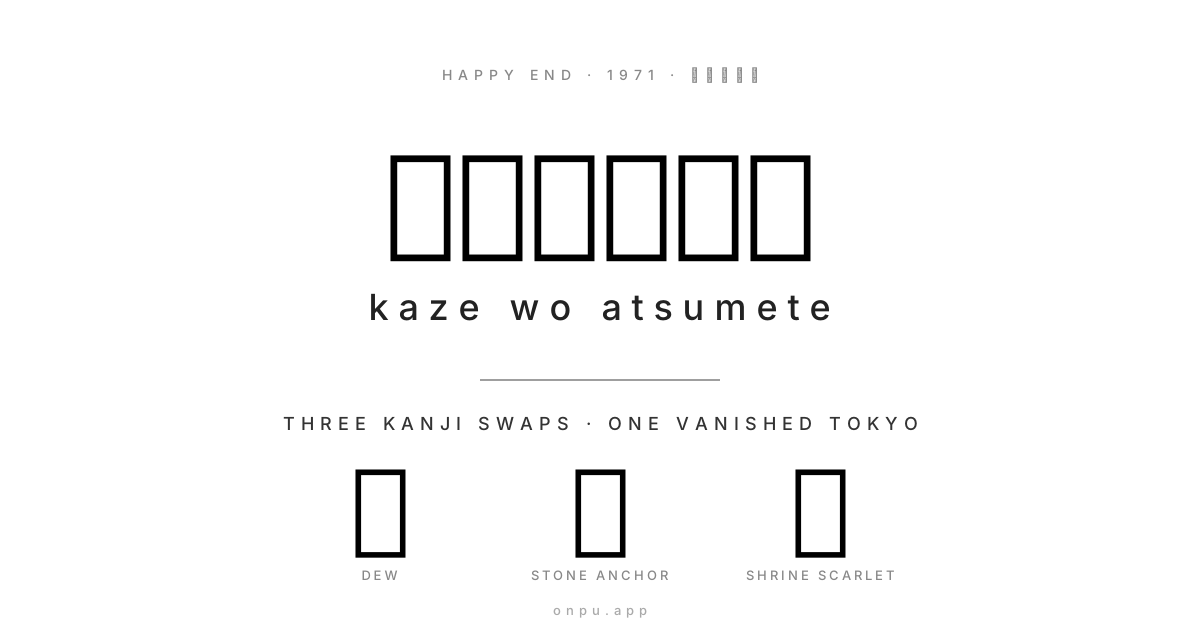
Happy End's 1971 hit hides three kanji swaps that smuggle a vanishing pre-Olympics Tokyo inside its streetcar, its harbor, and its scarlet sails.
Kaze wo Atsumete Meaning: The Lost in Translation Song Wrote 1971 Tokyo in Kanji That Already Felt Old in 1971
For most of us outside Japan, this is the song from Lost in Translation. The credits roll, Bill Murray is gone, the acoustic guitar comes up, and a soft, slightly nasal voice sings 風をあつめて, 蒼空を翔けたいんです.
Sofia Coppola put it there in 2003, and it instantly became the song every foreigner remembers from that movie. But in Japan, 風をあつめて is the song that ended an argument.
From 1970 to 1972, a debate ran in the Japanese music press called the 日本語ロック論争, the Japanese-language rock controversy. Could rock work in Japanese, or did it need English to feel like rock at all? Yuya Uchida said no. Happy End said yes, released 風街ろまん (Kazemachi Roman) in 1971, and the argument quietly ended. The proof was in the kanji.
What you'll learn
This post will take you about 5 minutes to read and you'll know:
- Why the album is named after a fictional district called "Wind Town"
- The kanji swap that turns a streetcar into something fragile
- The kanji swap that pins a harbor down with a stone
- The color word that flags an imperial Japan that no longer exists
- What "gather the wind" actually means once the kanji line up
A song about a city that wasn't there anymore
Kazemachi Roman is a concept album, and the concept is a Tokyo being demolished in real time as the band wrote about it. The 1964 Olympics had bulldozed huge stretches of the old city for highways and hotels, the streetcar network was mostly gone by 1971, and the wooden alley districts in Aoyama and Azabu (where lyricist Takashi Matsumoto grew up) were being flattened year by year.
So Matsumoto invented a district nobody could bulldoze. He called it 風街 (Wind Town). According to The Guardian, the lyrics for this specific song started with a line he saw scribbled in the bathroom of a Shibuya café called Max Road, from a poet named Anzai Fuyue. The song that became canon for Japanese rock started life on a café bathroom wall.
What I noticed once I actually read the kanji is that the song is set in modern 1971 Tokyo. Streetcars, harbors, coffee shops, skyscrapers. But the kanji Matsumoto chose for those modern objects are all wrong on purpose. They are the kanji of a Tokyo that was already gone. Three swaps are doing most of the work.
Swap 1: the streetcar that runs on dew
The first verse describes a 起きぬけの露面電車 crossing the sea at dawn. A just-woken streetcar cresting the water at first light. Dreamy image, slightly off, and the off-ness is in one character.
Standard modern Japanese for "streetcar" is 路面電車 (rōmen densha), literally "road-surface streetcar." The 路 is "road, path," the kanji on every Tokyo sign about tram routes. What Matsumoto wrote is 露面電車. Same reading, same word, but 路 has been swapped for 露.
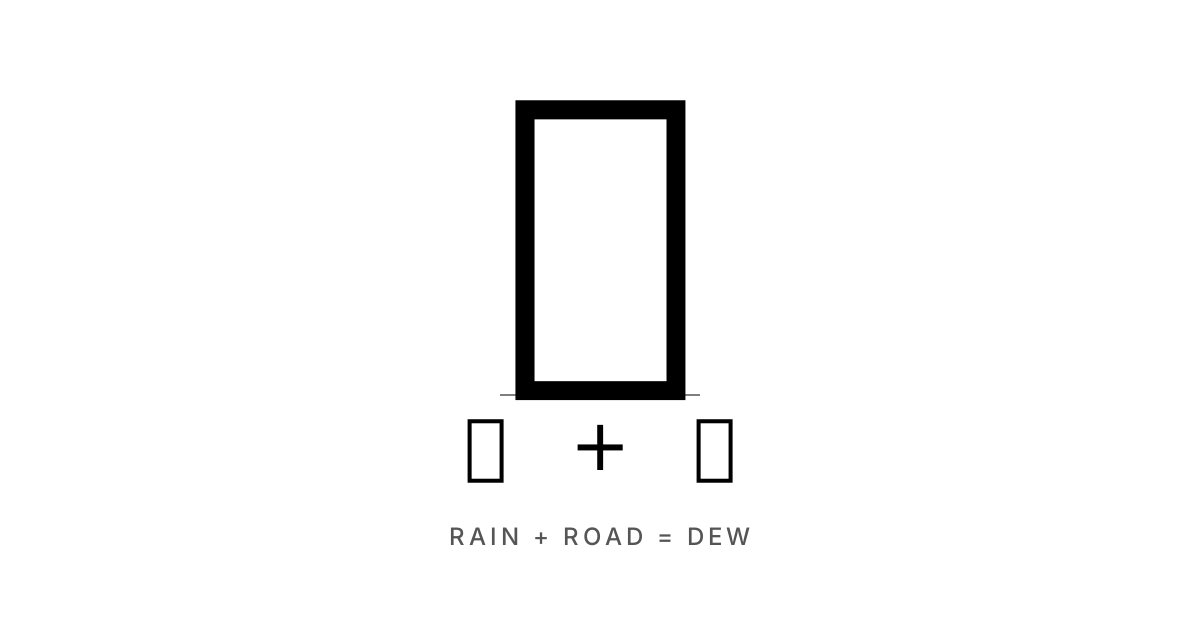
The kanji 露 means "dew." The breakdown is right there: 雨 (rain) sitting on top of 路 (road). Rain on a road, in the morning. That is what dew literally is.
So the streetcar is not running on a road. It is running on dew.
That changes the picture. Dew evaporates in minutes, the most temporary surface a thing could travel on. By 1971, most of Tokyo's streetcar network had been dismantled, replaced by buses and new subway lines. The trams still running were running on borrowed time, and the kanji Matsumoto picked is the kanji that says: this thing you are watching is already disappearing.
Swap 2: the harbor anchored by a stone
The second verse describes a city with crimson sails. The line ends with 碇泊してるのが 見えたんです, "I could see it, anchored."
Standard modern Japanese for "moored at port" is 停泊 (teihaku). The first kanji 停 means "halt, stop." A person (亻) standing in an arbor (亭). Someone who has paused. What Matsumoto wrote is 碇泊. Same reading, same meaning, 停 swapped for 碇.

The kanji 碇 means "anchor," specifically a stone anchor: 石 (stone) plus 定 (to fix in place). A stone that decides where you stay. Modern ships use steel anchors that lift cleanly. Old Japanese fishing boats used 碇, a literal stone tied to a rope, the kind that sinks into the seabed and stays.
So the city in the verse is not just stopped at port. It has been pinned. The readings of 碇泊 and 停泊 are identical, so if you only listen, you hear "the city was anchored." Read the kanji and you hear "the city was pinned to the bottom by a stone." Same scene, two completely different weights.
Swap 3: the color that flags an imperial Japan
The same verse describes 緋色の帆を掲げた都市. A city flying scarlet sails.
Modern Japanese has plenty of words for red: 赤色 (the generic one, the red on a stoplight), 朱色 (vermillion), 紅 (the deep crimson of lipstick or autumn leaves). Matsumoto picked 緋色, which is less a swap than a register choice.
緋 is one of Japan's traditional colors, and the contexts it shows up in are specific: the lacquered red of Shinto shrine pillars, the robes of certain Buddhist priests, the uniforms of Heian and later imperial guards, the ornamental carp called 緋鯉. The kanji itself is 糸 (thread) plus 非 (against the grain). A thread that goes against the standard.
Write 赤い帆 and the sails are just red. Write 緋色の帆 and they are the color of a Japan that pre-dates 1964. The color of shrines, imperial guards, an aesthetic that was being paved over while the band was in the studio. Every English translation I have seen renders 緋色 as "scarlet" and moves on. There is no way for the English word to carry what 緋色 carries in Japanese.
Why three swaps add up to one song
Once you see this pattern, the rest of the lyrics fall into the same shape. 珈琲屋 instead of コーヒー店 for the morning coffee shop. 玻璃 instead of ガラス for glass, a literary word that pre-dates the loanword. 蒼空 for the blue sky in the chorus instead of 青空, picking the deeper, more melancholy blue of old poetry.
Modern objects. Old kanji. Every verse.
The chorus is, depending on who you ask, the most famous line in Japanese rock: 風をあつめて 蒼空を翔けたいんです. I want to gather the wind and soar through the blue sky.
You can read it as a love song to flight, or as the dream of a young band proving rock could be Japanese. I think the kanji are doing a third thing. Every verse describes the lyricist looking at modern Tokyo and finding something fragile inside it: a streetcar made of dew, a city pinned by a stone, sails the color of vanishing Japan. Then the chorus says, gather it and lift it before it goes.
If this kind of layered kanji reading is the part of Japanese music you keep getting curious about, you might like the kanji choice in EGO-WRAPPIN's 下弦の月, the way 涙 keeps showing up in J-pop choruses, or the Portuguese loanword Porno Graffitti hides inside a Japanese chorus.
Try it yourself
If 風をあつめて is on your playlist, paste the lyrics into Onpu and let the breakdown do the rest. The 露 and 碇 entries each have their components mapped out, so you can see what is sitting inside the surface readings.
I would love to know which other Hosono songs hide this kind of swap. Kazemachi Roman has at least four more songs I have not finished decoding. If you find one, tell me what you spot.
FAQ
What does Kaze wo Atsumete mean in English?
風をあつめて translates literally as "gathering the wind." The full chorus 風をあつめて、蒼空を翔けたいんです means "I want to gather the wind and soar through the blue sky." It reads as a metaphor for taking hold of something fleeting and lifting it somewhere it can be preserved.
Who wrote and sang Kaze wo Atsumete?
The lyrics are by Takashi Matsumoto (松本隆), Happy End's drummer and one of the most influential Japanese lyricists of the last fifty years. The music is by Haruomi Hosono (細野晴臣), who also sang lead and later co-founded Yellow Magic Orchestra. The song appeared on Happy End's 1971 album Kazemachi Roman (風街ろまん).
What is the Japanese-language rock controversy?
In the early 1970s, Japanese music magazines ran a debate over whether rock could function in Japanese at all. Critics like Yuya Uchida argued rock was an English-language form and Japanese phonetics did not fit it. Happy End argued the opposite. The success of Kazemachi Roman (風街ろまん) effectively settled the debate in their favor and opened the door for the Japanese-language rock and pop that followed.