Kagen no Tsuki EGO-WRAPPIN' Meaning: Title Says Waning Moon, Chorus Says Filling Up
Kagen no Tsuki by EGO-WRAPPIN' means waning moon, but the kanji 弦 literally means bowstring and the chorus keeps saying filling up. Here's what the title actually encodes.
Kagen no Tsuki EGO-WRAPPIN' Meaning: Title Says Waning Moon, Chorus Says Filling Up
下弦の月 shows up on every late-night EGO-WRAPPIN' playlist. It's the one with the hand stuck in the shirt fabric, the threads that won't come undone, Yoshie Nakano's voice doing that thing where it almost breaks and then it doesn't.
Every translation I've seen calls the title "Waning Moon" and moves on.
I think the title is doing more than that.
This post takes about 5 minutes and you'll walk away with:
- Why 下弦 isn't a moon phase so much as a shape
- The contradiction that runs through every chorus (and why the song is built around it)
- What the kanji 弦 is actually drawing when you look at it
下弦 isn't a moon phase. It's a shape.
Let's break the title down.
下 is easy. Below, descend, down. It shows up in every beginner textbook.
弦 is the interesting one. It's an N1 kanji, and the dictionary glosses it as "bowstring, chord, hypotenuse." Not moon. Not light. Bowstring.
Here's the decomposition from Onpu's kanji data:
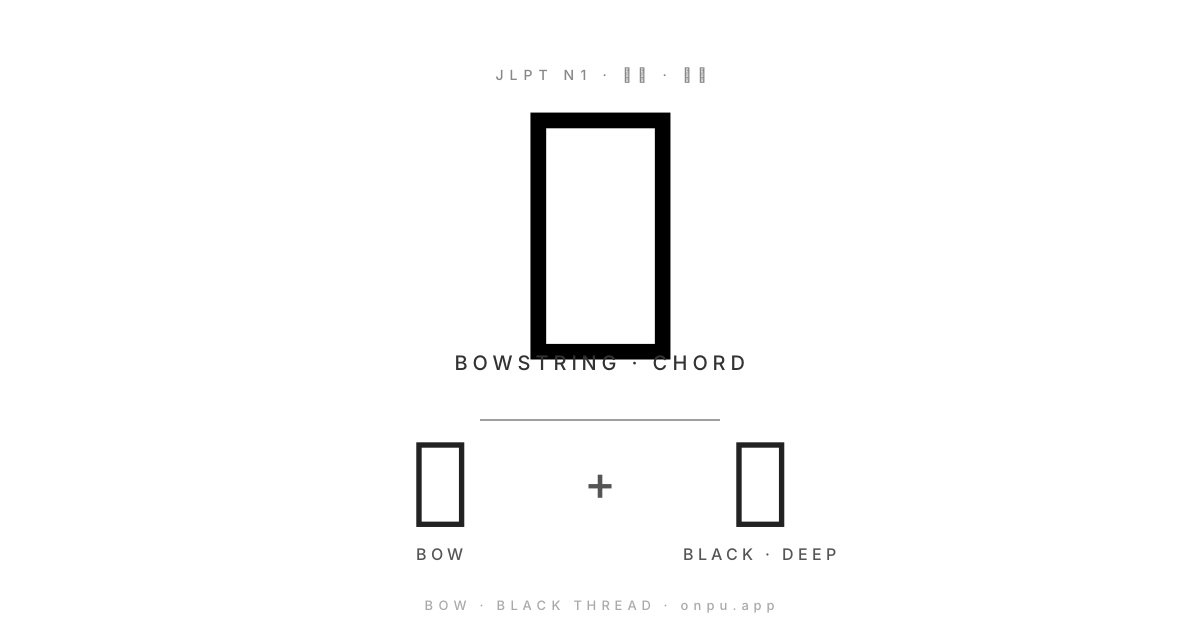
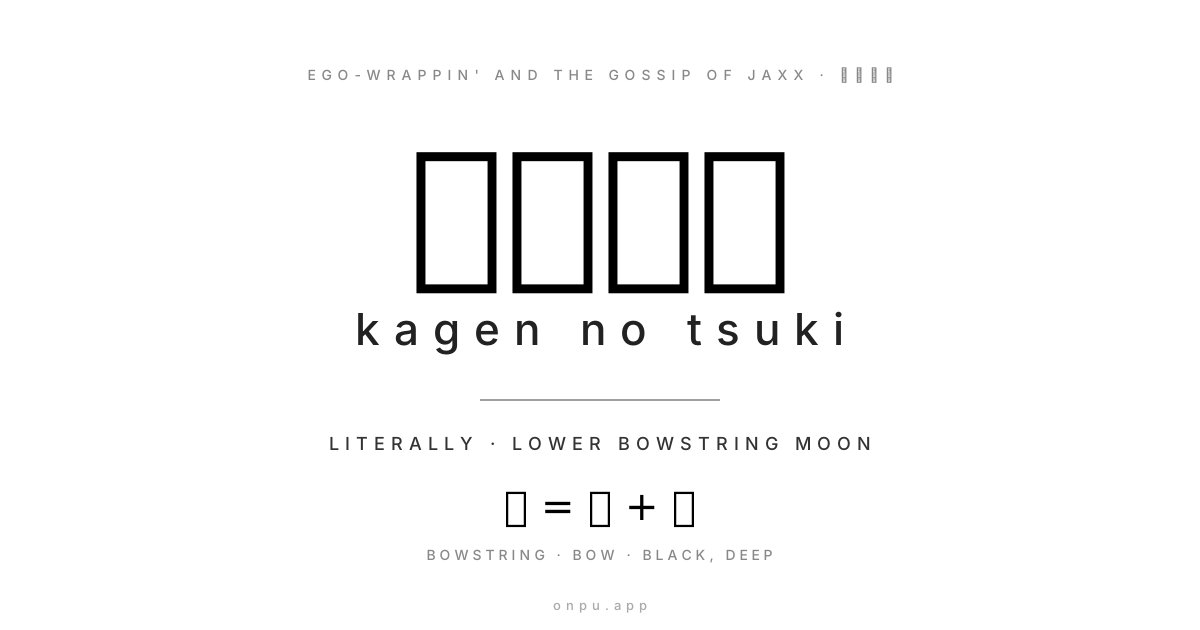
弦 = 弓 (bow) + 玄 (black, deep, mysterious).
So 下弦 reads, character by character, as "lower bowstring." That's the literal.
The astronomical meaning is a little buried. In traditional Japanese naming, a half-moon in the sky looks like a drawn bow, and the flat dark boundary between lit and unlit is the string of that bow. When the half-moon sets in the west, that flat edge points either up or down.
Up means 上弦. First quarter. The moon on its way to full.
Down means 下弦. Last quarter, the moon on its way to nothing, with its bowstring pointing at the horizon it's about to disappear behind. The kanji isn't describing where the moon sits in the lunar cycle. It's describing the direction of the bowstring in the sky.
Which means the title image isn't a fading disc. It's a drawn bow. A curve with tension in it.
Next time you see 弦 in a song title, look for the bow. Japanese titles sometimes encode the song's central image inside the kanji itself and this is one of them.
The chorus contradicts the title four times
Here's the part that made me stop and rewind.
The song is called 下弦の月. The last quarter. The waning half. In the Japanese moon cycle, 下弦 is the moon after full, on its way to nothing.
The chorus opens:
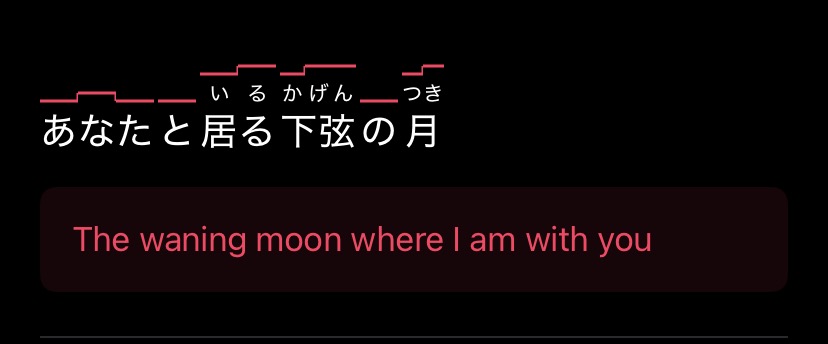
欠けていく ほら 心裸足 駆けだした あなたと居る 下弦の月
"Being chipped away. Look. My heart, barefoot, started running. With you, the waning moon."
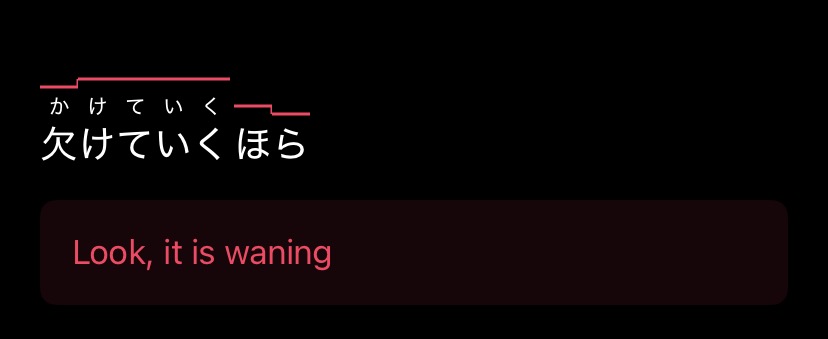
欠 is N3. It means "fail, gap, lack." The verb 欠けていく is what a moon does when it's losing light. It's the canonical Japanese verb for waning. So far, the chorus agrees with the title.
But then, immediately after:
満ちてく ほら 両手ひろげ 思い願う あなたと照らされたり 流れたり 溶けあったり
"Filling up. Look. With both arms open, I think and wish. Illuminated with you, flowing, melting together."
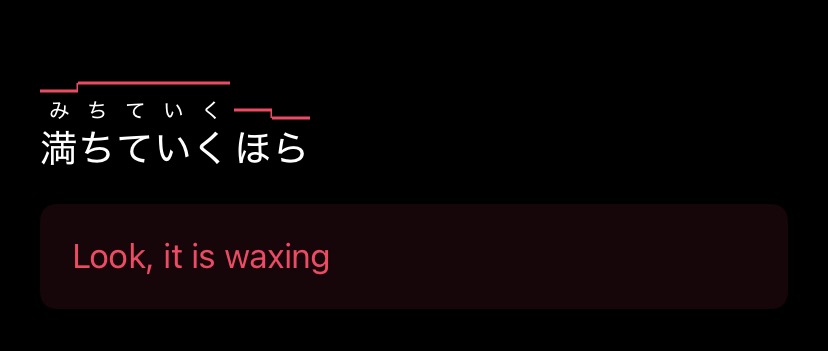
満ちてく is the exact opposite of 欠けていく. 満 is N2. It means "enough, full, fullness." 満ちる is the canonical verb for the moon becoming full.
The title picked a side. The chorus refuses to.
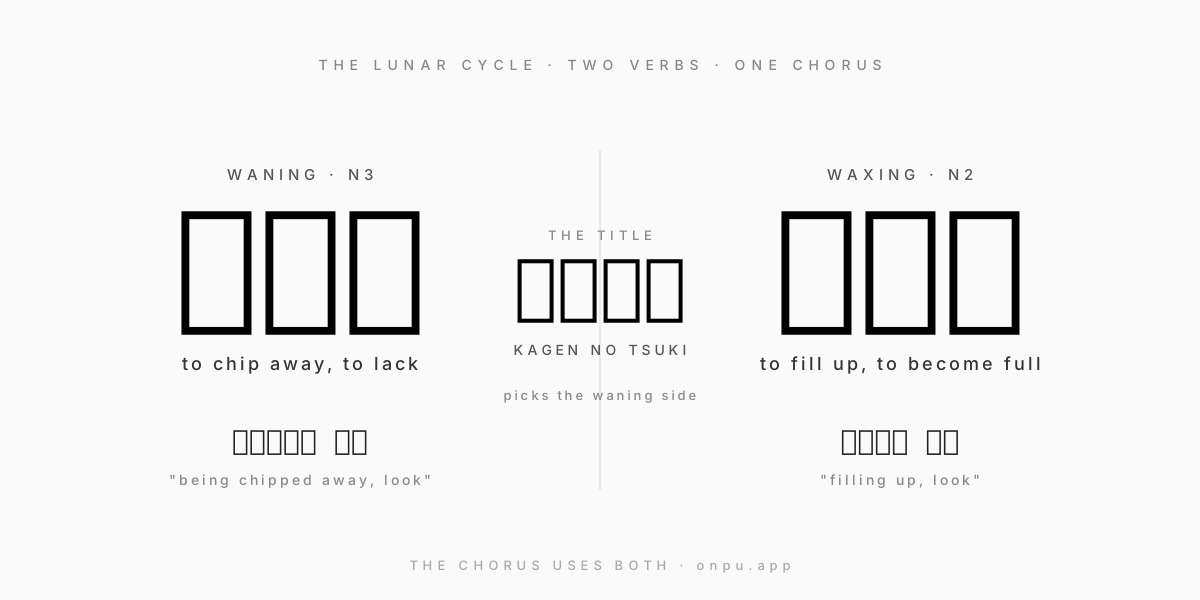
And it doesn't happen once. The structure repeats. 欠けていく opens a chorus, 満ちてく closes it, and then it runs back through. By the end of the song the two verbs have alternated four times. A moon chipping away. A moon filling up. A moon chipping away. A moon filling up.
This is the song. Two people leaving each other and pulling closer in the same breath, set against a moon that's doing both at once.
It's a pattern you can use outside this song too. When a Japanese title names a static moment but the chorus uses verbs that push in the opposite direction, that contradiction is usually the song's actual subject. The way サウダージ defines itself inside its own chorus works on a similar move: title as a word, chorus as the feeling behind the word.
Why the bowstring matters for the feeling
Zoom out for a second.
A bowstring isn't a violin string. It's not under steady tension. A bowstring is about to be released. The whole point of a drawn bow is that it holds energy it hasn't used yet.
Now read the song's opening again:
肌とシャツの間すっぽり 居心地のいい右手を たどれば糸が絡まり ほどけないまま
"Between skin and shirt, a right hand settled in, comfortable. When you trace it, threads get tangled. They won't come undone."
ほどけないまま. Won't come undone. The first image in the song is a thread under tension that refuses to resolve.
Then the title: a bow under tension that hasn't released.
Then the chorus: a moon caught between full and empty, refusing to land on one.
I didn't see this on my first few listens, I'll be honest. The melody is so warm and the voice is so close to your ear that I was just floating on it. It took sitting with the lyrics line by line to notice that every image in the song is the same image. Something pulled taut. Something held in place by tension. Something that hasn't let go.
That's what 下弦 is doing in the title. It's not labeling a moon phase for the listener's convenience. It's drawing the bow.
This is the same trick 狂乱 Hey Kids!! pulls with 狂, where the title's kanji keeps showing up through the chorus to tint every line with the same color. Here, the tint is tension.
One thing to try
If any of this is interesting, paste 下弦の月 into Onpu and read the chorus line by line. Watch 弦 get its furigana (かげん) and see the pitch accent flip between 欠けていく and 満ちてく. They really do sit right next to each other in the song, and seeing the two patterns side by side is different from hearing them.
I'd love to know what else is hiding in EGO-WRAPPIN' lyrics. This is the first one I really sat with. There are probably twelve more I haven't heard yet.
Lyrics quoted above are verified via j-lyric.net. Lyrics by Yoshie Nakano; composition by Masaki Mori and Yoshie Nakano.