Saudade Porno Graffitti Meaning: The Line Where This Song Defines Its Own Portuguese Title
Porno Graffitti's サウダージ is one of the rare J-pop songs that writes the definition of its own Portuguese title into the chorus. Here is the line.
Saudade Porno Graffitti Meaning: The Line Where This Song Defines Its Own Portuguese Title
サウダージ by Porno Graffitti is the kind of song whose melody is in your head before anyone explains the title. Released 2000, #1 on Oricon, covered endlessly. For years I treated "saudade" as a perfume I could not quite place, until I actually looked at the line where the word shows up.
Here is the thing most English-language write-ups leave out.
The song defines saudade inside its own chorus. One line. You do not have to import the concept from a Portuguese dictionary, because Shindo Haruichi already did the importing for you.
In this post, you will learn:
- What saudade is, in one honest sentence
- The exact line where the chorus teaches you what saudade means
- Why 恋心 keeps appearing, and why it is the Japanese shadow of the title
- What 恋 looks like when you split it into its two pieces
- Why the last line lives alongside love instead of inside it
5 min read.
Saudade is Portuguese, and it was borrowed on purpose
People love to call saudade "untranslatable," which is usually a lazy way of saying "nobody bothered to translate it." Here is a fair attempt.
Saudade is the feeling of missing something you loved that is now gone, held in a way that does not really want the thing back so much as it wants to keep the shape of the thing alive. Not grief exactly. Not nostalgia exactly. Portuguese fado singers built a genre around it.
Japanese has adjacent words. 切ない. 懐かしい. 寂しい. 未練. None of them sit in exactly the same spot on the map. So when Shindo Haruichi of Porno Graffitti wanted a title for a song about love fading at sunset, he reached over Japanese entirely and grabbed a Portuguese word.
Shindo does this. He did it again later with メリッサ, where the title is a plant name he found by accident in a dictionary. With メリッサ the accident was the point. With サウダージ the borrowing is deliberate, and he does not leave the word sitting on the cover like a perfume bottle label. He walks you through what it means.
The line where the song tells you what saudade is
About two-thirds of the way through the song, the narrator lands on this couplet:
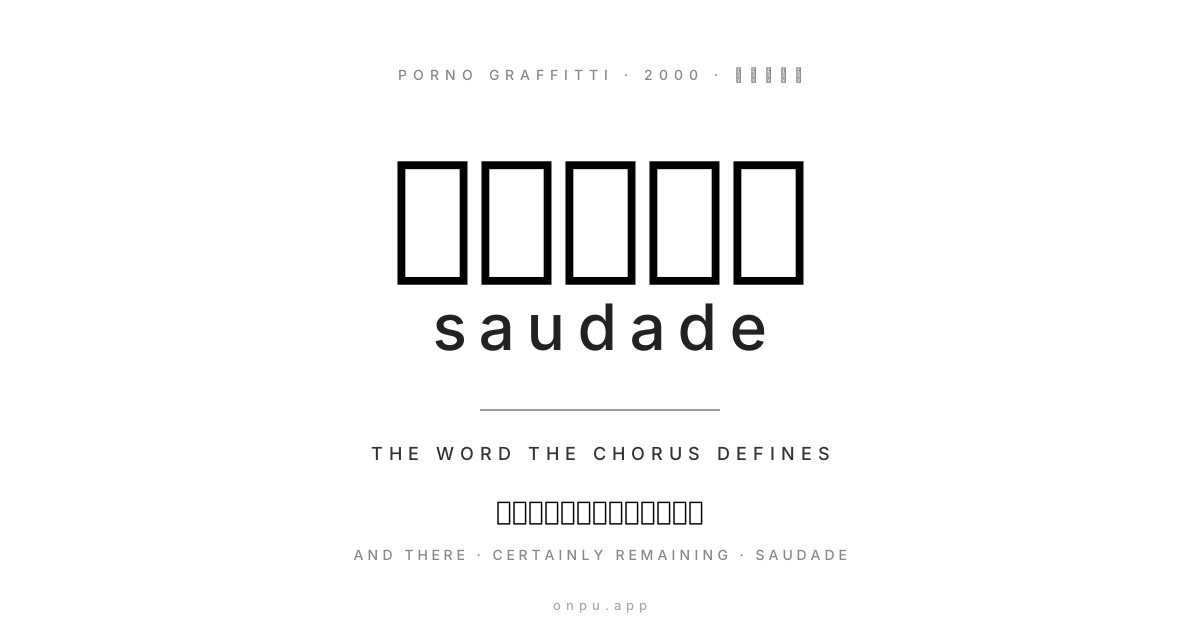
愛が消えていくのを 夕日に例えてみたりして そこに確かに残るサウダージ
A close reading:
"Trying to compare love disappearing to a sunset. And there, certainly remaining: saudade."
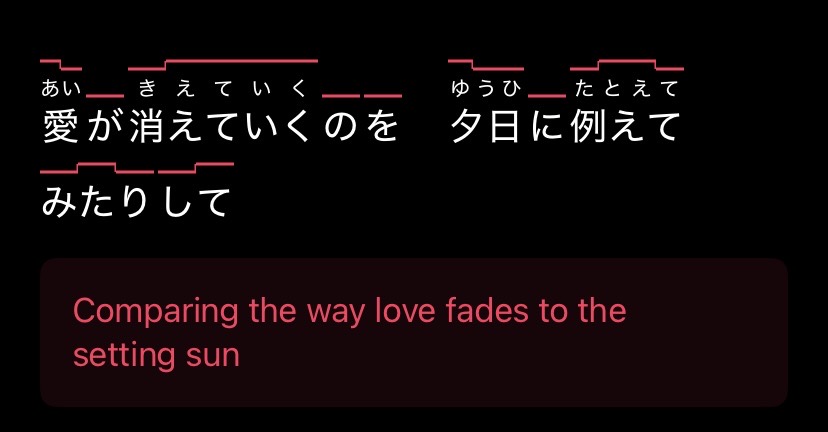
Read that twice. The narrator is not using "saudade" as a mood word, she is literally defining it. Love is a sunset. It fades. And in the place where the sun used to be, something still sits, the afterglow outlasting the event. That is the Portuguese word in the title.
The kanji in this couplet are built from first-grade characters on purpose. 夕日 (yūhi, evening sun) uses 夕 (N4, "evening") and 日 (N5, "sun, day"). 残 is N5, "remain, left." She builds the definition out of plain kanji and a plain image. The sun going down. The light that stays after it goes.
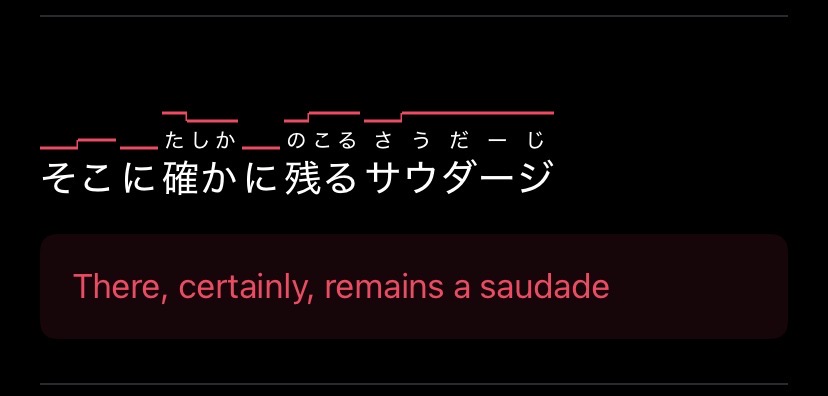
The move is, quietly, a linguistics lesson inside a ballad. If you have never heard the word saudade before, you learn it here. If you have, you get a clean Japanese frame for it.
恋心 is the Japanese shadow of saudade
Now pull the camera back and listen to the choruses. The narrator keeps calling out to the same thing by name. Not to the person who left. To her own feeling.
サヨナラ恋心よ 許してね恋心よ 諦めて恋心よ
"Goodbye, my love-feelings." "Forgive me, my love-feelings." "Give up, my love-feelings."
The word is 恋心 (koigokoro). It is an ordinary Japanese compound for "feelings of love," the kind of thing an English translator would flatten into "love" or "my heart." But something specific is going on once you notice the repetition.
She is not talking to him. She is talking to her own love as if it were a person standing next to her. She asks it to forgive her. She tells it goodbye. She tells it to give up.
That is the structure of saudade. The thing is gone, but the feeling about the thing is still here and has its own voice. Which is exactly what 恋心 lets her do.
恋 is literally "heart, again"
This is where the kanji get pretty.
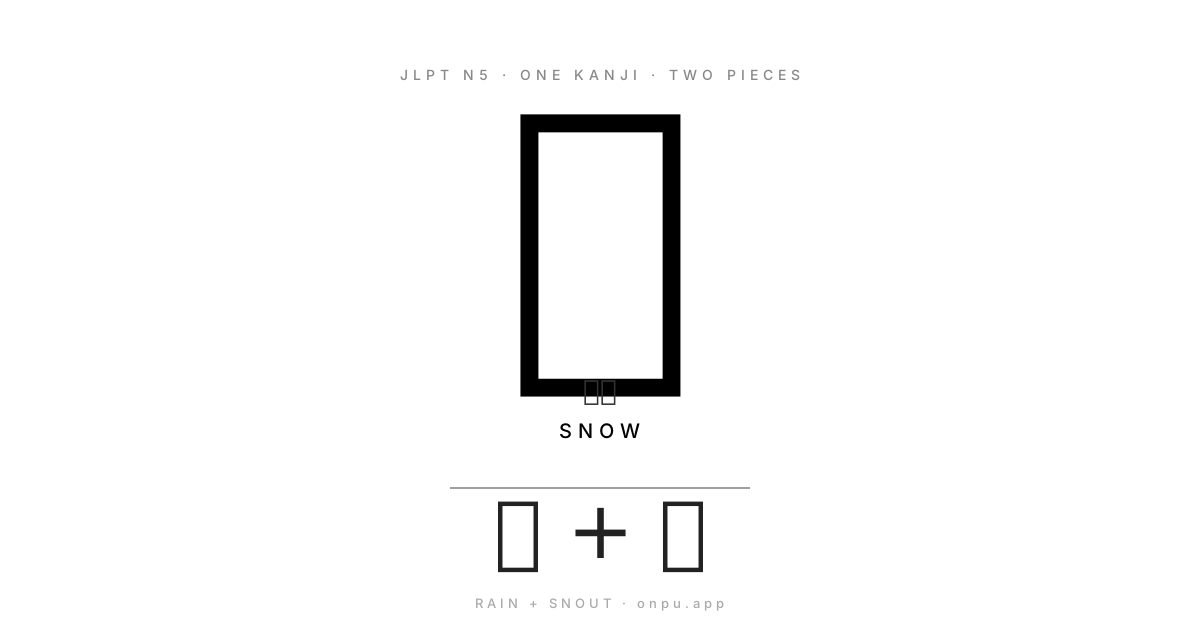
恋 is listed in kanji-data.json as an N1 kanji meaning "darling, in love, miss." It decomposes into two pieces:
- 亦, again, also
- 心, heart, mind, spirit
The mnemonic the app gives is gentle and accurate: "Heart (心) again (亦), in love."
Look at the shape for a second. 心 is a heart, three strokes curving around a chamber, two dots floating on either side. 亦 sits on top. Read the kanji top-down and you are reading "again, heart." Read it bottom-up and you are reading "heart, again." Either way, it is saying the same thing: this emotion is not a one-shot event. It loops.
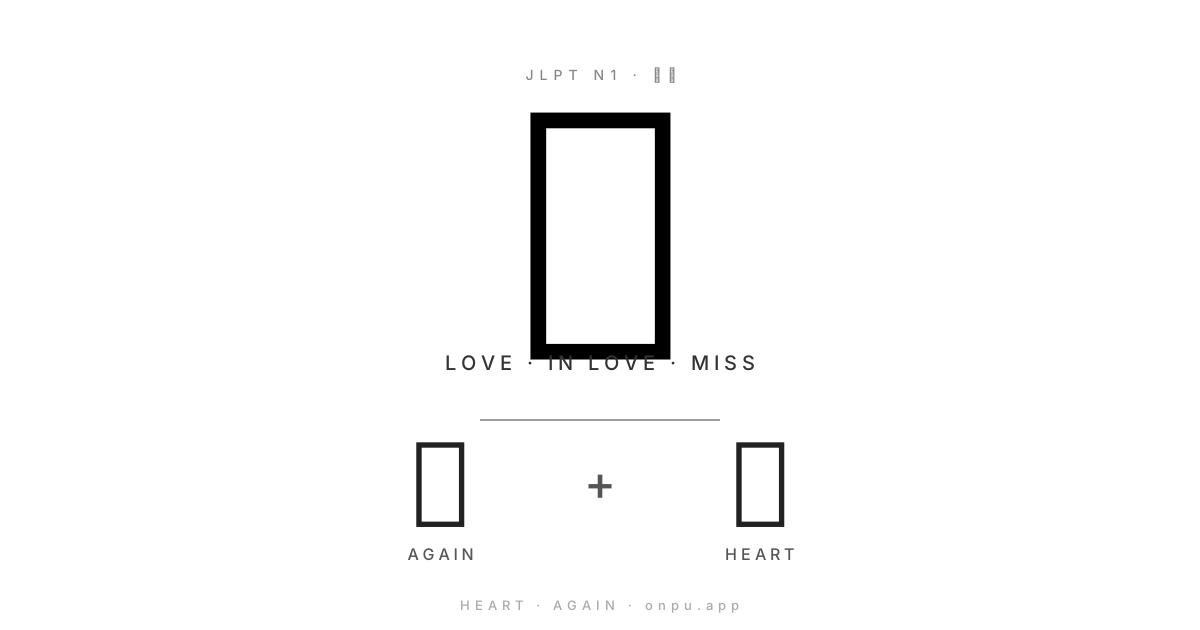
That is the kanji the narrator is addressing across four choruses. Not 愛 (ai), which is the bigger, steadier word for love. 愛 shows up in the line about love fading like a sunset, as the thing that actually disappears. What remains is not 愛. What remains is 恋心. Heart, again.
If you want to get tidy about it, that is a near-perfect glyph for saudade. The event ends. The heart keeps looping.
I am not going to claim Shindo picked 恋心 because the kanji 恋 decomposes this way. But the song writes saudade into one line and then spends the rest of its runtime on a conversation with her own looping heart. The two pieces agree.
The last line lives alongside 恋心, not inside it
The very last line of the song is this:
夜空を焦がして 私は生きたわ恋心と
"Scorching the night sky, I lived. Together with 恋心."
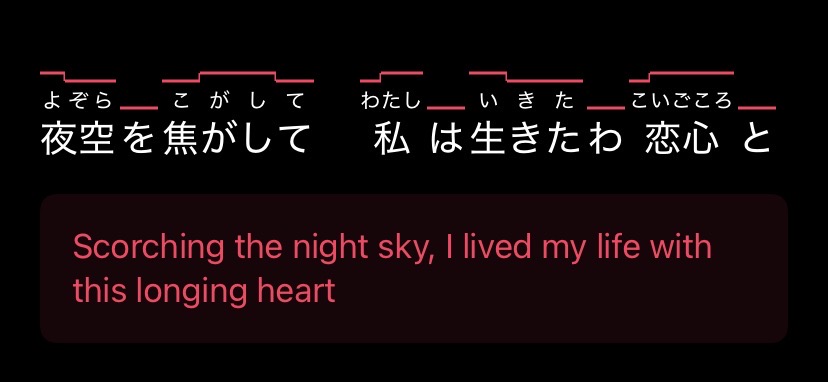
The kanji 焦 is worth a second. kanji-data.json lists it as N4, "burn, impatient." It is built from 隹 (an old bird radical) on top of 灬, the fire radical that shows up as four dots at the bottom of characters. A bird over fire. 焦がす is what you do to a yakitori skewer when you leave it on the flame a beat too long.
So the narrator scorched the night sky. Not lit it, not decorated it. Burned it. That is the mark she left.
The real trick of the line, though, is the final particle. 恋心と. That と is not "with" in the sense of owning or using. It is "with" in the sense of being accompanied, the と you use when you go somewhere alongside a friend. 友達と行く is "I went with my friend." 恋心と生きた is "I lived, alongside my love-feelings."
She is not saying "I lived a life of love." She is saying "I lived, and my love-feelings lived alongside me the whole time." A companion, not a possession. Which, once you have the song's definition of saudade in hand, is the exact ending you would expect. The love was the sunset. What she lived with was the afterglow.
This keeps being the Porno Graffitti move
Once you know to look for it, the pattern shows up across their catalog. A foreign-sounding or loanword title, then a Japanese song underneath that is quietly doing something the title alone would never tell you. アゲハ蝶 hides a butterfly-on-a-leaf image inside the title kanji, and other acts pull similar moves, like KIRINJI's エイリアンズ, which uses a borrowed English plural on the title and then drops it in the final chorus. Whenever a Japanese song has a title in katakana or a non-Japanese word, there is a good chance the title is a lever the songwriter is pulling.
サウダージ is the cleanest example I have found of that move. Foreign-word title, chorus that defines the foreign word, four minutes of verses illustrating it.
If you love this song already
I do not have a unified theory of Portuguese loanwords in Japanese pop. What I do have is a habit, now, of actually reading the line the foreign word sits inside, because most of the time the song has already done the translation for me.
If saudade is already on your playlist, paste it into Onpu and skip to where 愛が消えていくのを 夕日に例えてみたりして lands. Watch サウダージ show up in the very next line. Then listen for 恋心 across the rest of the song. The whole four minutes reorganize around that one moment.
I would love to know if you hear it the way I do now. It is a quiet reveal, easy to miss on autopilot, which, speaking from experience, most of us were.