Ageha Chou Porno Graffitti Meaning: The Title Kanji Is Already a Butterfly Resting on a Leaf
PornoGraffitti's アゲハ蝶 is not just a song about a butterfly. The kanji 蝶 is a picture of a bug on a leaf, and one verb in the final chorus makes the butterfly bloom.
Ageha Chou Porno Graffitti Meaning: The Title Kanji Is Already a Butterfly Resting on a Leaf
If you have spent any time in a karaoke box in Japan, you have heard this song. Porno Graffitti released アゲハ蝶 as their sixth single in June 2001 and the chorus has been floating around karaoke rooms for more than twenty years since. Fullmetal Alchemist fans probably know the same duo from メリッサ. This one is older, softer, and built around a single image: a swallowtail butterfly appearing on a summer night, under the moon, and never quite being reached — the kind of bright-sounding song with heavier subject matter underneath that you only notice once you start reading the lyrics.
I must have heard the song a hundred times before I looked at the title properly.
The two kanji on the cover are already doing work the English title can't. 蝶 isn't a label stuck on a butterfly. It is a tiny picture of one. And later in the song, the butterfly does something butterflies don't do in Japanese: it blooms.
In this post, you'll learn:
- Why 蝶, the kanji for butterfly, is already a picture of a bug on a leaf
- How the song quietly threads leaf imagery through the whole lyric (even inside the word for "word")
- What the final chorus does when it uses a flower verb on the butterfly
- What the closing line is actually asking for
5 min read
The title character is already drawing the butterfly
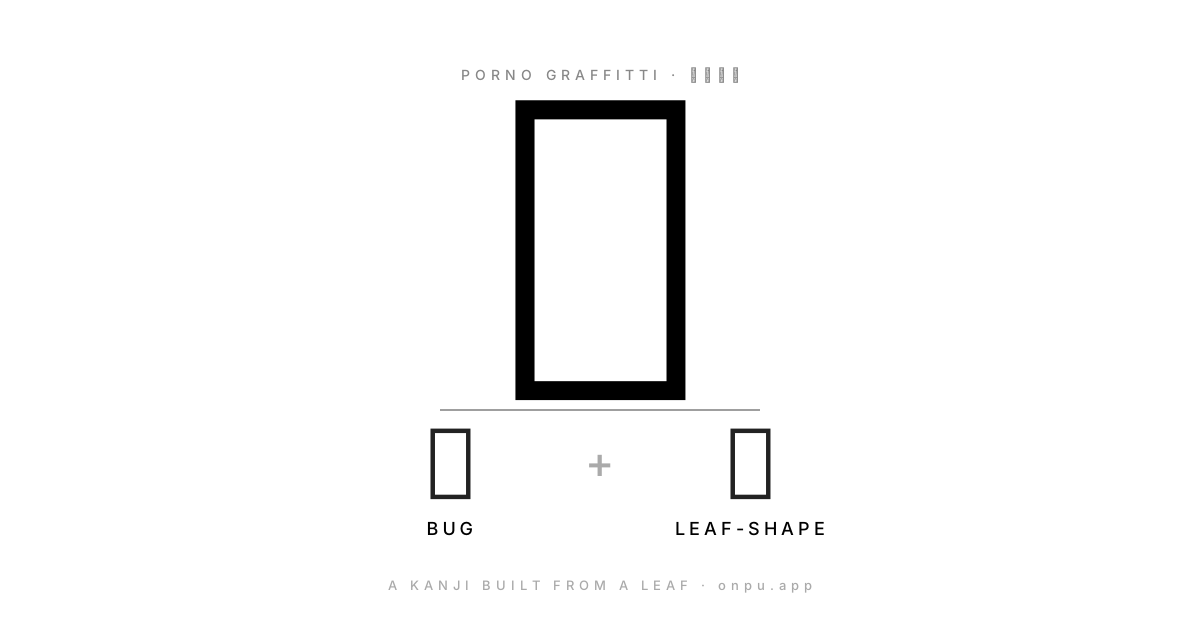
Look at 蝶 for a second. It is an N1 kanji, which means most learners meet it late, usually through words like 蝶々 (chouchou, butterfly-butterfly, the word small kids reach for first). Split it in half and you get two pieces.
On the left: 虫, the character for bug or insect. The one you already know from 昆虫 (konchuu, insect) and 毛虫 (kemushi, caterpillar).
On the right: 枼, a component most people will never see on its own. It is described in the Onpu data as "a flat piece, a slip, a leaf-shape." A thin, flat, horizontal thing. The kind of surface a bug might rest on.
That is the whole kanji. A bug, next to a thin flat shape. The character is not describing a butterfly. It is drawing one, perched.

Japanese learners sometimes hear that "kanji are little pictures" and then hit a wall, because most of them aren't. 国 is not a picture of a country. 愛 is not a picture of love. But every so often the character really is doing what the beginner poster said it was doing. 蝶 is one of those. The song picks it up and builds a whole summer night out of it.
The same leaf-shape sits inside the word for "leaf"
This is the part I didn't see coming.
葉, the N5 kanji for "leaf," decomposes into 艹 (the grass radical) on top of 枼. That 枼. The same flat-piece component that sits on the right side of 蝶.

So the kanji for butterfly and the kanji for leaf are sharing a part. A bug, next to a leaf-shape, is the title of the song. A little grass, on top of a leaf-shape, is the word for leaf. The characters were built this way centuries before Porno Graffitti wrote a word of this lyric, but once you know the shape is repeating, you start catching it elsewhere in the song.
Like here, in the middle of the second chorus:
詩人がたったひとひらの言の葉に込めた意味を shijin ga tatta hitohira no koto no ha ni kometa imi wo the meaning a poet pressed into a single word-leaf
言の葉 (koto no ha) is an older, more poetic way to say "word." Modern Japanese just says 言葉 (kotoba). The archaic form keeps the の in the middle, which exposes what the word is literally built from: 言 (speech) + の + 葉 (leaf). A speech-leaf. And it pairs here with ひとひら, a counter for petals and flakes and thin flat things that drift.
One petal-thin word. Pressed full of meaning. The butterfly perched on a leaf-shape. The poet breathing into a word-leaf. The imagery is running on one engine.
The verb that makes the butterfly bloom
Now the second move, which I find gorgeous.
Across the song, the verbs attached to the butterfly are exactly the verbs you would expect for a butterfly. In the opening image:
ひらりひらりと舞い遊ぶように 姿見せたアゲハ蝶 hirari hirari to maiasobu you ni, sugata miseta agehachou a swallowtail butterfly that showed itself, fluttering about as if dancing
舞い遊ぶ is the compound "dancing-playing," which is exactly what butterflies do in Japanese. Then 姿見せた, literally "showed its form." These verbs are on-brand for a butterfly. Fine. Pretty. Expected.
And then the final chorus opens like this:
荒野に咲いたアゲハ蝶 kouya ni saita agehachou a swallowtail butterfly that bloomed in the wilderness
咲いた. 咲く. Saku. To bloom.
咲く is a flower verb. You use it for sakura. You use it for plum blossoms. You use it for roses. You absolutely do not use it for insects. Butterflies flutter, dance, flit, rest. They do not bloom.

The song flipped the verb on purpose. And once it does, the butterfly is not something in motion anymore. It is something rooted. Something that unfurled in the ground the way a flower would unfurl. The speaker is looking across a wasteland at a butterfly that grew there, and that is what makes it unreachable. Not because it can fly away. Because it will not.
The rest of that final verse stays inside the flower logic. The butterfly is an オアシス (oasis) that the speaker can't reach. The speaker begs for 冷たい水 (cool water). A butterfly doesn't need water. A flower in a wasteland does.
What the closing line is actually asking for
So the song has spent five minutes building a butterfly that cannot come to the singer. And then it ends on this:
僕の肩で羽を休めておくれ boku no kata de hane wo yasumete okure please rest your wings on my shoulder
肩 is N4. Shoulder. The kunyomi 'kata' is the one you already use if you've ever talked about being tense.
Here is what that closing line does. The butterfly that bloomed in the wilderness cannot be reached. The singer has just admitted as much. So he stops moving toward the butterfly and makes himself into the resting place instead. Come land here. You don't have to fly. I'll be still.
Of all the body parts the song could have picked for this line, 肩 is the one a butterfly can actually land on. Not 手 (hand). Not 胸 (chest). A shoulder. Something broad, flat, and steady. Something a flying thing could set down on without needing to think.
The song closes not by catching the butterfly but by becoming somewhere it might rest. That is a pretty quiet way to end a pop song about what Japanese calls 切ない — that particular ache of wanting something you can see but can't hold.
Closing
What I had missed for years was in the kanji on the cover. 蝶 is a bug on a leaf-shape, and 葉 is a little grass on the same leaf-shape, and 咲く is a verb for flowers that the final verse applies to a butterfly anyway. None of this is coded — much like Kyouran Hey Kids front-loading its whole mood into the two stacked kanji of 狂乱, it is all sitting in characters that are centuries older than the song, waiting for someone to point at them.
If you want to see it for yourself, paste アゲハ蝶 into Onpu and long-press the 蝶 in the title. You will see the bug and the leaf-shape fall apart. Then scroll to the final chorus and look at 咲いた, a flower verb showing up where you would expect a butterfly verb. Two small moves. One song that has been quietly doing them since 2001.