Aliens KIRINJI Meaning: The Plural in the Title Turns a Lonely Song Into a Love Song
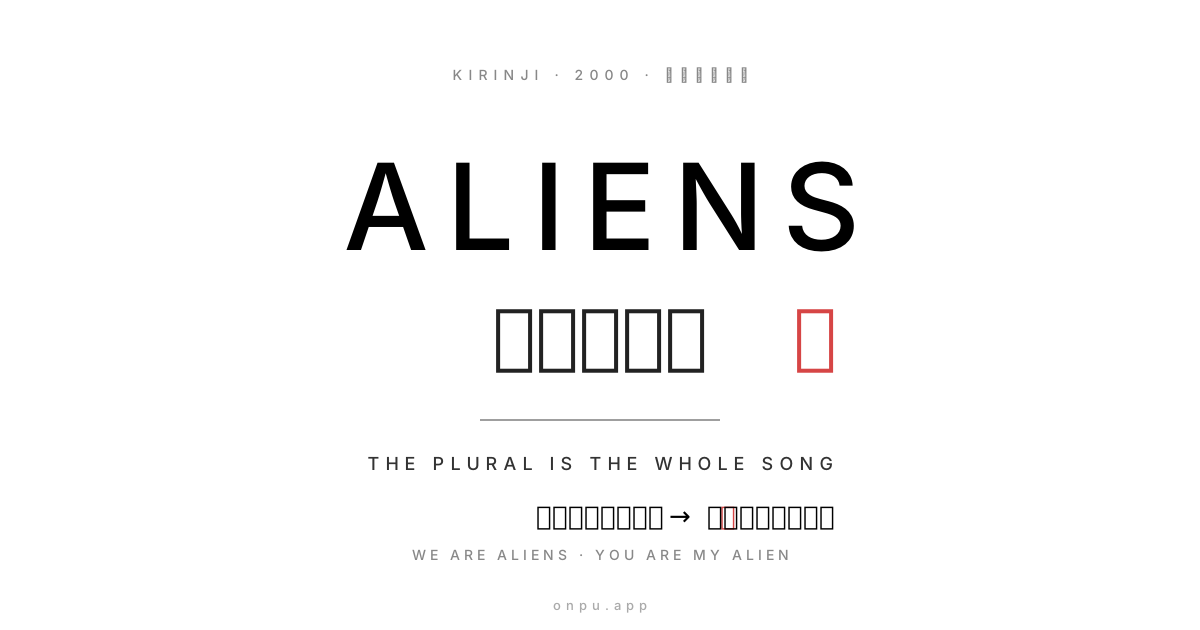
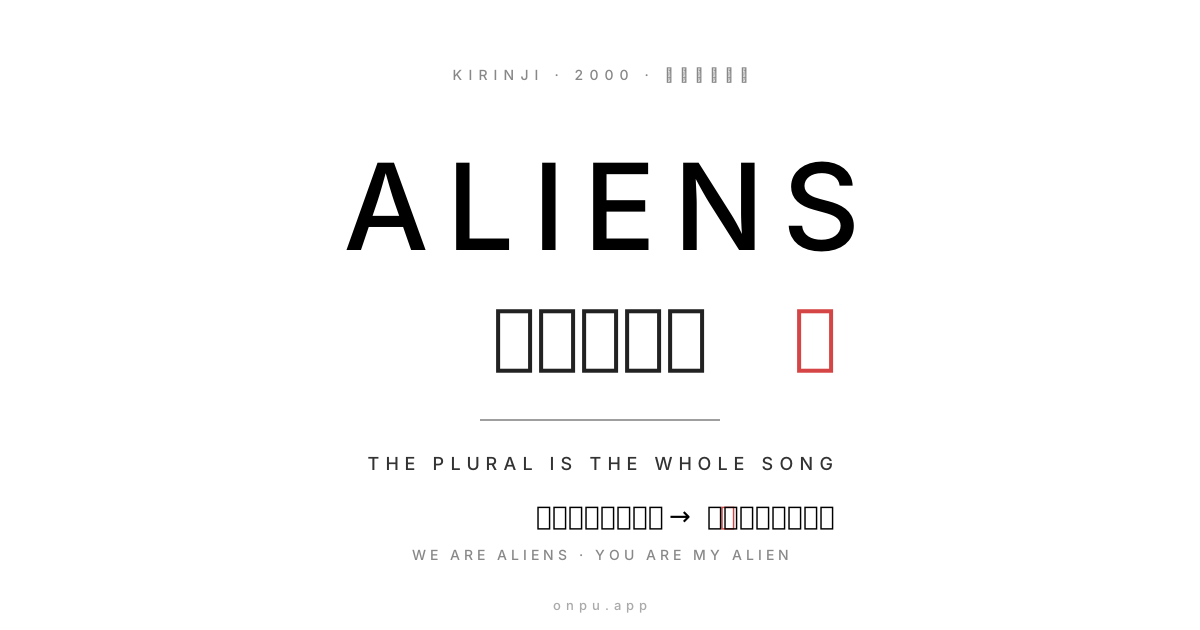
KIRINJI's エイリアンズ is plural in the title and singular in the final line. That one letter flip is the entire song: we are weirdos together, and you are mine.
Aliens KIRINJI Meaning: The Plural in the Title Turns a Lonely Song Into a Love Song
エイリアンズ by KIRINJI is one of those songs that a lot of Japanese music fans treat as a quiet, holy object. Released in 2000 on the album 3 by Horikome Yasuyuki and his brother, covered endlessly, soundtracking very specific late-night drives for a very specific kind of person. I came to it late, and for a while I heard it as a song about loneliness. Two people alone in a big indifferent city.
Then I actually opened the title.
Here is the thing I did not notice for a long time, because English speakers usually do not.
The title is エイリアンズ, plural. The final line of the song is キミが好きだよ エイリアン, singular. One letter is doing all the work.
In English "Aliens" and "Alien" sit next to each other in a dictionary and do not feel that different. In Japanese, the ズ at the end of エイリアンズ is a borrowed English plural marker, pinned onto a katakana loanword. When Horikome wrote the title with ズ and then dropped the ズ in the closing line, he quietly rearranged the whole song. The chorus is about us. The last line is about you.
In this post, you will learn:
- What the ズ on the end of エイリアンズ is actually doing
- Why 月の裏 is the perfect image for loving someone you cannot fully know
- How 禁断の実 smuggles two meanings into one phrase
- The line where the narrator stops addressing the couple and starts addressing her
- A peer way to read this song in Onpu without getting lost
5 min read.
The ズ is borrowed English, used on purpose
Japanese does not usually mark plurals. 猫 can mean cat or cats. You have to pick up the count from context.
Katakana loanwords are different. When a word is borrowed from English, it often drags the English grammar with it. ファン (fan) becomes ファンズ only rarely, but in song titles and band names you will see ズ thrown on the end when the artist wants to highlight a group. キッズ, ガールズ, ボーイズ. It is not standard Japanese grammar, it is stylistic English-flavoured plural, and it only shows up when somebody chose to put it there.
Horikome chose to put it there. The song is called エイリアンズ, not エイリアン.
Now look at the final chorus. The narrator lands on:
キミが好きだよ エイリアン Kimi ga suki da yo, eirian. I love you, alien.
The ズ is gone. He is not addressing "the aliens" any more. He is addressing one specific person, and he is calling her alien in the singular, the way you might call somebody "weirdo" as a term of endearment.
The arc is hiding in plain sight in the title. The chorus claims "we are aliens together," 僕らはエイリアンズ. The closing lines peel that down to "you, in particular, are my alien." A love song dressed as a loneliness song.
月の裏 is the far side of the moon, and that is the point
About a third of the way in, Horikome writes:
月の裏を夢みて Tsuki no ura o yumemite. Dreaming of the far side of the moon.
This line sits right next to him holding the person he loves and calling them an alien. The image is doing something specific.
裏 is an N2 kanji, and it is listed in kanji-data.json with the meaning "amidst, back, in" and the mnemonic "Kettle lid (亠) on the village home (里), the back side." The components are 亠 (kettle lid radical) sitting on top of 里 (village, parent's home). A lid over the inside. The character is about what is on the other side, the hidden face, the reverse.
裏 shows up everywhere in Japanese once you know it. 裏口 is a back door. 裏話 is the behind-the-scenes version of a story. 裏表 is literally "back and front," used for two-facedness. You land on 裏, you are talking about the side people are not meant to see.
月の裏 is the far side of the moon. From Earth, tidal locking means we only ever see one face of the moon. The other face is there, permanent, real, but turned away from us every second of our lives. You cannot look at it without leaving the planet.
This is what Horikome puts next to a lover. He is holding her, and he is dreaming of the side of her he cannot see. Not complaining. Not suspicious. Just gently acknowledging that even in the closest possible intimacy, there is a permanent hidden face.
The word alien takes on a completely different color once 月の裏 lands. She is not an alien because she is strange. She is an alien because there is a whole hemisphere of her that is turned away from him, and he loves her anyway.
禁断の実 is forbidden fruit, and also forbidden truth
A few lines earlier, in the same chorus, comes this:
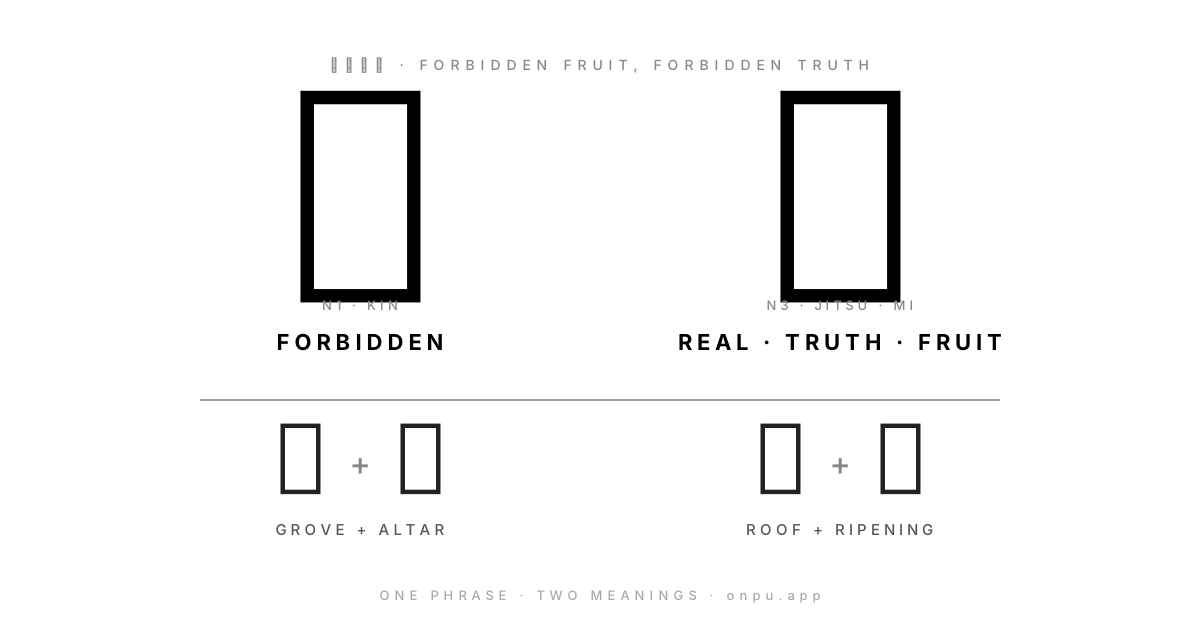
まるで僕らはエイリアンズ 禁断の実 ほおばっては Marude bokura wa eirianzu. Kindan no mi o hoobatte wa. It is as if we are aliens. Stuffing our cheeks with forbidden fruit.
禁断の実 is the standard Japanese phrase for "forbidden fruit," the Garden of Eden reference. On the page it is three kanji doing very tidy work.
- 禁 (N1, "ban, forbid, prohibition"): kanji-data.json gives the mnemonic "Forest (林) on display (示), forbidden." The character is 林 (grove) sitting on 示 (altar, a thing shown or declared). Read literally, it is a grove set apart with a sign posted. A sacred wood with a keep-out on it. That is the mood of the kanji, a boundary you are not supposed to cross.
- 実 (N3, "real, truth, fruit"): kanji-data.json gives the mnemonic "Crown (宀) over the real fruit (𡗗), truth." The character is 宀 (a roof) sitting over 𡗗. The dictionary meaning is listed as "real, truth, fruit", in that order.
That second kanji is the interesting one. 実 is both "fruit" and "truth." The word 真実 (shinjitsu, truth) uses it. The word 現実 (genjitsu, reality) uses it. The word 果実 (kajitsu, fruit) uses it. In modern Japanese, the same character carries both readings because they grew out of the same root idea, the thing that ripens into being real.
Which means 禁断の実 reads as "forbidden fruit" and quietly carries the shadow of "forbidden truth." The lovers in the song are not just eating a banned apple. They are also tasting a banned reality. A version of themselves the rest of the world is not supposed to see.
I want to be careful here. Horikome has not, as far as I can find, sat down in an interview and said "I chose 実 because it means both truth and fruit." I am not going to put words in his mouth. What I can say is that the kanji itself carries both meanings in its dictionary entry, and any fluent reader of Japanese looking at the line is aware of both. The song's title is about weirdos on the wrong planet. The chorus puts "forbidden truth-fruit" in their mouths. The two images rhyme on purpose, whether or not Horikome planned them down to the radical.
この星のこの僻地 says they are aliens on their own planet
Here is the line that, once you hear it, never lets you hear the song the same way again:
この星のこの僻地で Kono hoshi no kono hekichi de. In this corner of this planet.
星 is "planet" or "star." 僻地 (hekichi) is a real Japanese word that means something like "the boonies," an out-of-the-way backwater, a remote rural corner. You would use it to describe a village so small the bus only comes twice a day.
Horikome is using it to describe where he and his lover are standing, right now, on Earth.
The framing is cosmic, because that is the trick of the whole song. "Alien" is a word for someone from another planet. But the song is not about being visited by extraterrestrials. It is about two people who are from this planet and still feel like they landed here. The boonies of the universe. The narrator is basically saying: out of every place in the cosmos we could have washed up, we washed up together in this particular nowhere, and I am going to do magic for you here.
That matches the next line, 魔法をかけてみせるさ いいかい, "I will cast a spell for you, okay?" It is a very small promise. Not a grand cosmic gesture. A guy telling a girl he will make their specific corner of Earth feel enchanted, because that is the version of magic you can actually do.
The arc: we are aliens, you are my alien
Once you have all these pieces, the arc of the song is easy to trace.
In the opening verses, Horikome sets up the scene. A quiet night, a highway, a couple who cannot sleep, traffic noise somewhere, a sports car breathing fire. Ordinary and slightly off.
The first chorus lands on 僕らはエイリアンズ. We are aliens, plural. And he pairs it with 月の裏 and 禁断の実, the two images of things that are hidden and forbidden. The chorus is the declaration of a private kingdom of two.
The second chorus repeats 僕らはエイリアンズ, now while they walk under streetlights. Same declaration.
And then, at the end, キミが好きだよ エイリアン. "I love you, alien." The plural is gone. The address is single. The whole "we are aliens" structure collapses into a quiet confession to one person.
The song is not about being alienated from the world. It is about choosing a person to be alienated with, and then choosing, at the end, to stop hiding behind the "we" and look her in the eye.
This is the kind of reveal katakana titles are great for
Once you learn to read a katakana title as a deliberate choice, you stop missing this kind of thing. The presence or absence of a ズ, a small "ッ," a dot in the middle, all of it is signal.
You have seen this on the blog before. Yorushika's 言って. hides the difference between 言った (said) and 逝った (passed away) in a single homophone, and the song tilts from plea to eulogy on one kanji swap. Kenshi Yonezu's Lemon uses one kanji to cover both "bitter" and "suffering" in consecutive chorus lines. Vaundy's 踊り子 quietly shifts the narrator's pronoun mid-song, and the whole song rereads.
エイリアンズ belongs on that shelf. The title is in katakana with a borrowed plural. The final line drops the plural. The song is about what changes between those two moments.
Closing
I am not going to pretend I know Horikome's full intention when he wrote this song. I have the lyrics, the title, and the kanji the lyrics sit inside. Those agree with each other.
If you love this song already, sit with it one more time. Paste エイリアンズ into Onpu. Watch the ズ at the end of the title. Listen for 僕らはエイリアンズ in the first chorus and キミが好きだよ エイリアン at the end. Let the plural peel off. Feel the song stop being about two people being alien to the world and start being about one person being alien to the other, in the good way.
That gap, the ズ that is there and then not there, is the entire love story.