Odoriko Vaundy Meaning: The Pronoun Shift Every English Translation Misses
Vaundy's Odoriko switches from 僕 to 私 halfway through. Here's the two-voice structure English translations flatten, plus what 踊り子 really means.
Odoriko Vaundy Meaning: The Pronoun Shift Every English Translation Misses
Odoriko has been sitting in the top streaming charts in Japan since Vaundy dropped it in November 2021. I've got the とぅるるる stuck in my head right now. You probably do too, especially if you clicked the title.
I listened to this song for about a year before I noticed something weird about verse three.
The narrator changes.
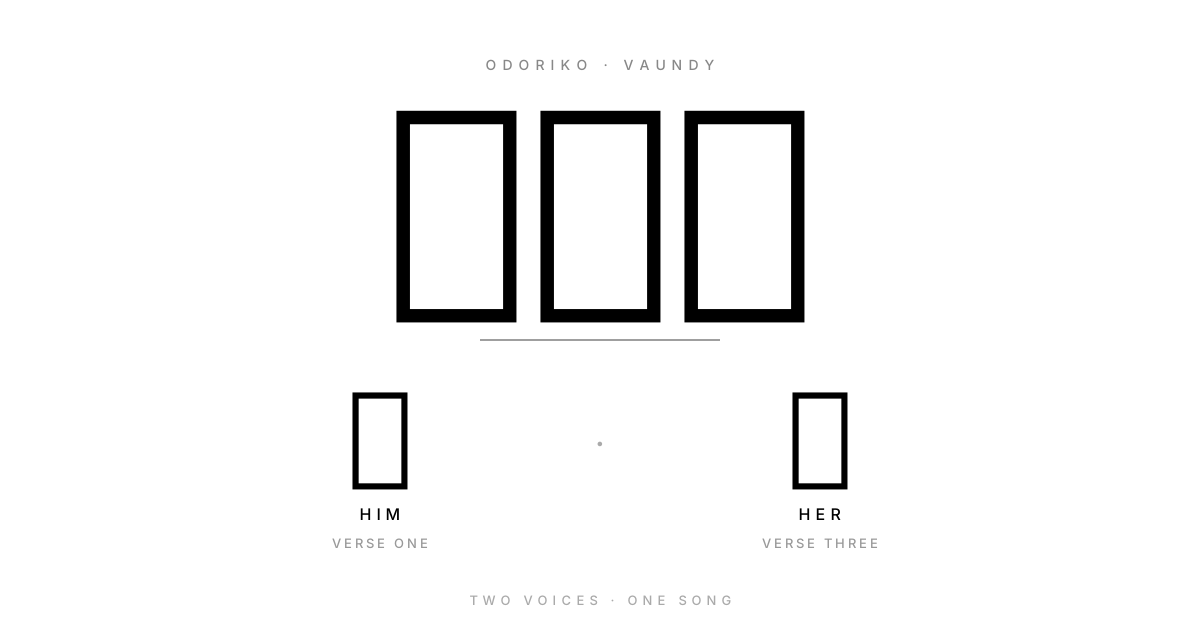
Verse one is 僕 (boku). Verse three opens with あのね, 私. Same song, different person. Every English translation I checked renders both pronouns as "I" and the shift disappears. In Japanese, it's impossible to miss.
In this post, you'll learn:
- What 踊り子 actually means, and the three layers stacked inside that word
- The exact line where the narrator changes from him to her
- 被害者づら, a phrase the English subtitles flatten into "as victims"
- Why 散って (scatter) is the saddest verb Vaundy could have picked
- How the two voices connect at the end of the song
6 min read
You know the turururu. You might not know who's actually singing.
Release date: 2021-11-17. Lyrics, music, and vocals: all Vaundy. The MV stars Nana Komatsu dancing alone in a gym.
Here's what almost nobody outside Japan picks up on: the lyrics are a dialogue.
Japanese doesn't force a pronoun into every sentence the way English does, so when a song puts one in, it's a choice. Vaundy uses exactly two first-person pronouns: 僕 (boku) and 私 (watashi). 僕 is masculine-coded. 私 reads as neutral or feminine, and paired with あなた (anata, "you") addressed outward, the listener hears someone else entirely. That's what happens in verse three.
踊り子 isn't just "dancer." It's three things stacked on top of each other.
Before the voices, the title.
踊り子 literally breaks down into dance + ing + person. A dancer. That's the first layer, and for most Japanese-English dictionaries it's the only one.
The kanji is doing some work. 踊 is built from 𧾷 (the foot radical, a variant of 足) plus 甬, which means something like "a road with walls on both sides." A narrow corridor. Dance is a foot thing done along a constrained path. You're not wandering. You're moving inside a frame. (For another song that goes deep on this kanji: NIGHT DANCER uses the same 踊 kanji as the one verb that finally breaks its frozen verses.)

The second layer shows up the minute you ask a Japanese reader what 踊り子 makes them think of. The answer is usually Izu no Odoriko: Kawabata Yasunari's 1926 novella about a Tokyo student on a solo trip to Izu who becomes quietly attached to a young dancer in a troupe of traveling performers. Kawabata won the Nobel Prize in 1968. The story is on every Japanese high school reading list. "Odoriko" in a literary context carries that whole weight: a performer you cross paths with once, can never keep, and remember for the rest of your life.
The third layer I didn't see coming. 踊り子 is also the name of an actual JR Limited Express train, running from Tokyo to Izukyū-Shimoda since 1981, named directly after Kawabata's novella. A few Japanese fans online have pointed out that とぅるるる fits the rough shape of a phone ringing or a platform chime.
Pick whichever reading lands for you. The song stays beautiful. But when you realize 踊り子 could be referring to a dancer, a memory of a lost love, AND the actual train the narrator is leaving on, the whole track quietly shifts. Next time you listen, try picturing a platform.
The song changes narrators. English turns both of them into "I."
Back to the pronoun thing.
Verse one opens like this:
ねぇ、どっかに置いてきたような 事が一つ二つ浮いているけど
Hey, there's one or two things floating in my head like I left them somewhere.
No pronoun yet. The chorus follows:
回り出した あの子と僕の未来が 止まりどっかで またやり直せたら
That girl's and my future started spinning. If it could stop somewhere and we could start over.
僕 lands on the word 未来 (mirai, future). The speaker is a 僕. He's thinking about an あの子 ("that girl") who used to be part of his future.
Then verse three hits and everything changes:
あのね、私あなたに会ったの 夢の中に置いてきたけどね ねぇ、どうして私が好きなの 一度しか会ったことがないのにね
Hey, I met you. I left you behind in the dream, though. Why do you like me? We've only met once, you know.
Two pronoun flips in four lines. 私 (watashi) in place of 僕. あなた (anata) addressed outward, meaning the あの子 is now doing the talking and the 僕 has become the you she's speaking to.
In English, both voices render as "I." The reader can't tell the speaker switched — see how Kiryu's Pararirai pulls the same pronoun-flattening trick on a different register. A few translators add a note. Most don't.
In Japanese the switch is a neon sign. There's a whole fan reading (NHK's 妄想かみ砕きミュージック built a re-interpreted music video around this exact theory in 2023) that Odoriko is a two-voice track. He calls. She watches the phone ring. Neither of them answers. I can't tell you that's what Vaundy meant. What I can tell you is that the Japanese text supports that reading, and the English version doesn't even let it exist.
Next time you listen, try this. Assume verse one is him. Assume verse three is her. See what the とぅるるる between the verses starts to sound like.
被害者づら, the phrase that gives the song its self-awareness
Inside the chorus there's a line that I spent months hearing as pure sadness before I actually translated it.
あの子と僕が被害者 づらでどっかを また練り歩けたらな
If that girl and I could put on victim face and walk around somewhere together again.
被害者 (higaisha) is a real word: a victim, someone who's been harmed. づら (also written 面) attaches to the end and means "face" or "expression." Put them together and 被害者づら literally means "victim face." The standard English gloss is "playing the victim."
It's a slang construction. Japanese speakers use it about a coworker who causes a problem and then complains about the meeting it created. It has a tiny mocking edge to it. You're calling out someone who's acting wounded when they were also part of the damage. Lyrics translation sites render the line as "as victims" or "wearing the mask of victims." Those carry the meaning. They lose the register.
What the Japanese line actually does: the 僕 knows they were both complicit. Neither of them is innocent. What he wants is to go back to the version of them where they could pretend they were, blaming the world instead of each other. That's different from sadness. That's self-aware sadness. Which is sadder.
Next time you hear a Japanese song and the English subtitle feels flat, look for 〜づら or 〜面. It's a dead giveaway that something slangy is happening underneath.
散って, when they scatter, the love song stays
The outro is the last piece I want to show you, because it's where the two voices do something together.
時代に乗って僕たちは 変わらず愛に生きるだろう 僕らが散って残るのは 変わらぬ愛の歌なんだろうな
Riding the times, we'll keep living in love, probably. What stays after we scatter is probably the unchanging love song.
散る (chiru) means scatter, disperse, fall. Its most famous usage in Japanese is for 桜 (sakura) petals. The kanji decomposes into 龷 on top and 攵 underneath, with 攵 being the radical for strike / forceful action. 散 is literally structured around pieces flying apart.

When a Japanese writer picks 散る for a song about two people drifting apart, they are pulling on the entire 桜 tradition. Cherry blossoms. Mono no aware — if you want the Japanese word for this specific cherry-blossom ache, 切ない, that's a whole register of feeling with no clean English translation. The beauty of the thing ending. That's a cultural reflex. You don't have to flag it to Japanese listeners, they hear it immediately.
And then Vaundy pairs it with 変わらぬ愛の歌, the unchanging love song. The people scatter. The song doesn't. That is the answer to the two voices. 僕 and 私 don't reconnect inside the track. They don't need to. The thing that survives them is the thing you're listening to right now, and the minute you know that, the とぅるるる between the choruses starts sounding a little bit like time passing.
Next time you notice 散 in a lyric, assume cherry blossoms are in the room, even if the song never says so.
Paste it into Onpu and watch the voices line up
The pronoun trick is the hardest thing to unsee once you've seen it. You won't hear Odoriko the same way again, which is either a gift or an inconvenience depending on how attached you were to the version in your head.
If you want to see it on the page, paste 踊り子 into Onpu and scroll to the verse that starts with あのね. 私 will be sitting right where the 僕 was five minutes ago, with あなた pointed back the way it came. Tap the kanji to see the breakdowns I used in this post.
I'm sure there's another layer I haven't found yet. If you also listen to Vaundy, paste Odoriko in and tell me what verse three sounds like now.