Kaze (風) Shows Up in Almost Every J-Pop Song You Love. The Same Kanji Hides Inside the Words for Scenery, Tradition, and the Common Cold.
風 means wind. It also means style. It also hides inside the word for the common cold. Once you see all three living in one kanji, J-pop sounds different.
Kaze (風) Shows Up in Almost Every J-Pop Song You Love. The Same Kanji Hides Inside the Words for Scenery, Tradition, and the Common Cold.
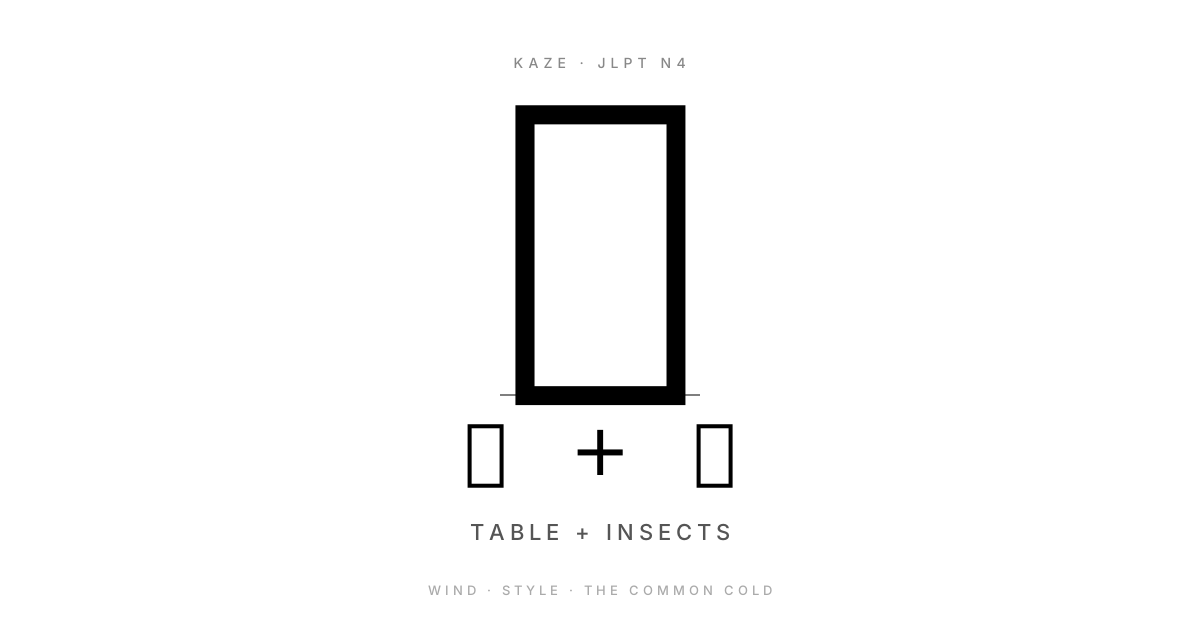
There is a J-pop chorus you have heard, probably more than once, where the singer holds one word a beat longer than the line needs. The strings open up under them. The word that lands on top of the bar is kaze.
That word is 風.
It is one of the first kanji a Japanese learner picks up. It is also one of the strangest. The same single character is doing three completely separate jobs at once. It is the wind in the sky. It is the style of something, the way you say "Japanese style" or "Western style." And it is hiding inside the everyday word for the common cold, the one your coworker uses when they call in sick.
Here is what you'll find in the next few minutes:
- What the kanji 風 is actually a picture of, and why "insects on a table" is the closest English explanation
- Why the same character carries wind and style in one breath
- The hidden third job: how 風 ended up inside the word for catching a cold
- The Happy End song that quietly pulls on all three at once
The kanji is insects on a table
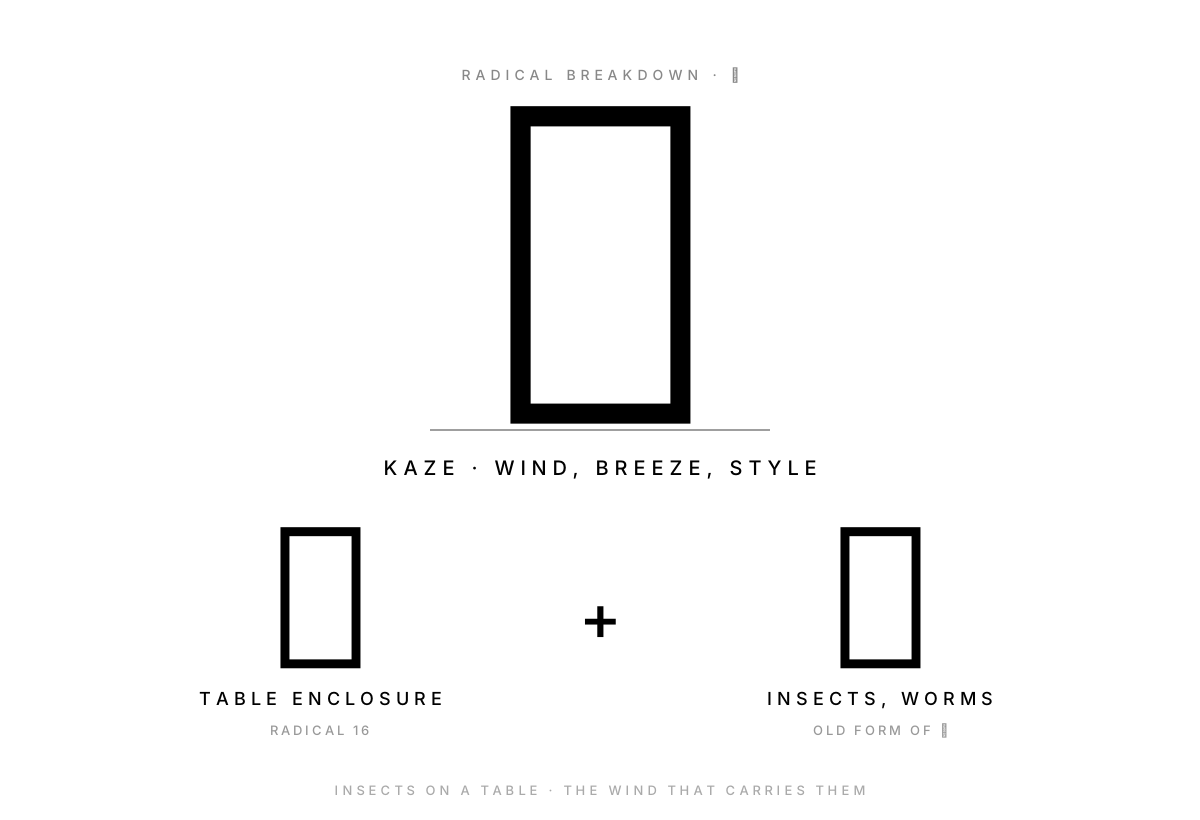
Most kanji are built from smaller pieces, and once you see the pieces you cannot stop seeing them. 星 (star) is 日 (sun) plus 生 (life). 海 (sea) is 氵 (water) plus 每 (every). The character is two ideas sitting next to each other, telling you what the word came from.
風 follows that rule, but the pieces are odd ones.
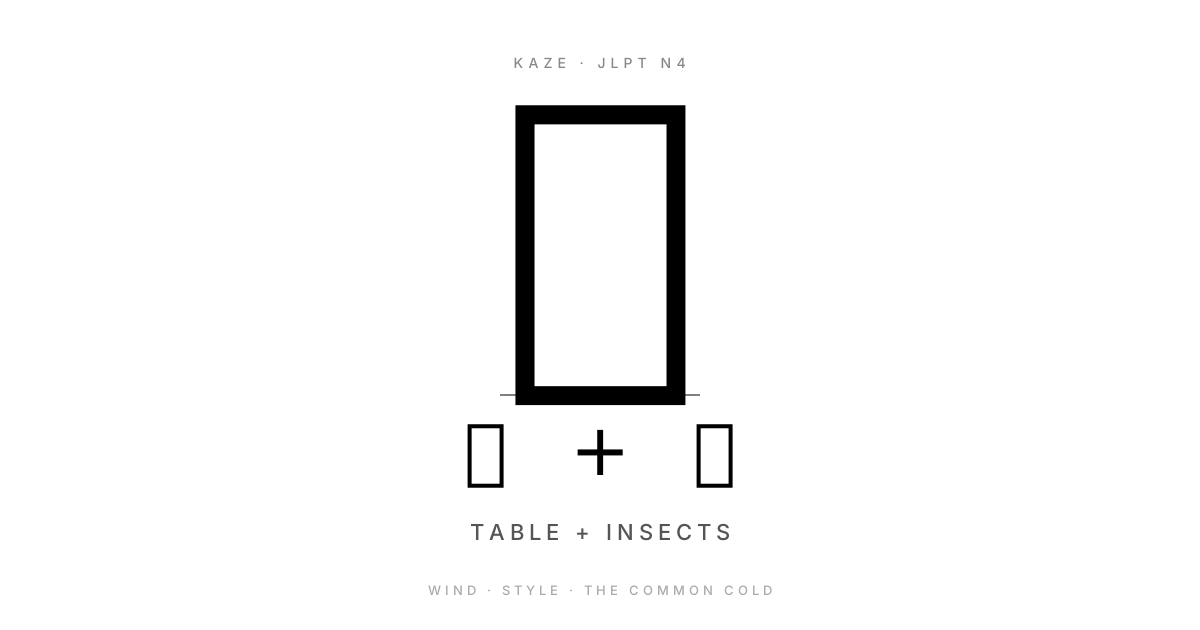
The outer shape is 几, which the kanji dictionary glosses as "table" or, more precisely, "table enclosure." It is the same shape that turns up in furniture words and counter words for low, flat things. Inside that enclosure sits 䖝, the old form of 虫, meaning "insects" or "worms."
Insects on a table. That is the literal Onpu breakdown for the kanji that means wind.
I sat with that for a while. It does not feel like wind. Wind in English suggests open sky, hair moving, kites. Insects on a table is the opposite of all of that. Contained. Small. A little gross.
The image starts to make sense once you remember where the kanji came from. In early Chinese cosmology, wind was not empty air. It was the medium that carried things. Smells, weather, illness, and yes, bugs. The kanji captures the older idea: the wind as a force that brings things along with it. Whatever is on the table got there because the wind put it there.
Once you see that, the modern uses of 風 stop looking random.
The same kanji means style
The first surprise hits in compound words.
和風 (wafuu) is Japanese style. As in: a 和風 restaurant has tatami and sliding doors instead of booths. A 和風 sauce is the soy-and-mirin one rather than the cream one. 洋風 (youfuu) is the opposite, Western style. 中華風 (chuukafuu) is Chinese style.
In every one of those, 風 is functioning as a suffix. Not "wind." Style. The way a thing carries itself.
That is not a coincidence either. Once you remember that wind, in the kanji's original mind, is a force that carries something along, it is a short jump to the feeling a thing carries and then to the style a thing has. Both ideas live inside the same character because, several thousand years ago, they were the same idea. The Japanese language inherited the compression and kept it.
There is another compound that lives in this same family. 風景 (fuukei) means scenery or landscape, but the literal pieces are 風 (wind) plus 景 (view, scene). A landscape is "the scene the wind is carrying." A pre-modern way of saying: this is the world as it is being delivered to me right now, by the air, by the season, by the moment.
A J-pop title with 風景 in it is doing more than describing a postcard. It is invoking the idea that the scenery is being handed to the listener by something larger than the singer.
Next time you see 風 used as a suffix in a Japanese phrase or song title, try reading it as "in the style of" first. If the sentence works, you have found one of the kanji's three jobs without using a dictionary.
The same kanji is the cold you catch in winter
Here is where it gets strange.
風邪 (kaze) is the modern Japanese word for the common cold. The kind you stay home from work for. The kind your coworker has when they text you that they need to take the day off.
The reading is kaze. Identical to the word for wind. The compound is 風 (wind) plus 邪 (evil, wickedness). Literally, "evil wind."
This is not a metaphor a clever songwriter invented. It is the leftover skeleton of a much older idea. In classical Chinese medicine, illness was caused by a malign wind entering the body through the pores or the mouth. The cold you catch in February was, specifically, an evil wind that found you while you were not watching.
Modern Japan still uses the word. The bacterial reality is understood now. The kanji never updated, because language is older than germ theory and does not bother rewriting itself when the science changes.
What this means for songs is quiet but real. When a Japanese lyric uses the word kaze, the listener's ear cannot fully separate the meanings. A line about wind in your hair sits adjacent, at the level of pure sound, to a line about catching a cold. A line about the style of something carries the same vibration as the line about the wind that brings it. Three meanings, one word, one breath.
If you have ever wondered why a Japanese song about wind feels more loaded than the same word would feel in English, this is part of why. The English word "wind" is single-purpose. The Japanese word kaze is doing three things at once.
When all three jobs land in one song
The clearest place I have heard this happen is in Happy End's 1971 song 風をあつめて (Kaze wo Atsumete), the track Sofia Coppola used in Lost in Translation. The English title is usually given as "Gathering the Wind."
The title alone is doing a lot of quiet work.
On the surface it is wind in the literal sense: harbor breezes, streetcar drafts, scarlet sails. That is the layer the English title captures.
Underneath, it is doing the style job. The album the song lives on, 風街ろまん (Kazemachi Roman), uses 風 in its title to mean a city of a certain character. "Wind town" is not the right English. "A Tokyo that carries a particular feeling" is closer.
And there is the third reading, the haunted one. The album is a song cycle about a Tokyo that, by 1971, had already mostly been demolished and rebuilt. The wind in these songs is also the wind that takes things away. Streetcar lines vanished. Harbors changed. The breeze in the chorus is doing all three jobs at once.
I cannot prove the lyricist Matsumoto Takashi sat down and consciously braided the three meanings together. What I can say is that the kanji makes the braid possible. The English title cannot do this. The Japanese title does it without trying.
The compounds you have been hearing without noticing
Once you start tracking 風, it shows up everywhere in J-pop and in the language around J-pop.
風物詩 (fuubutsushi) is hard to translate. The literal pieces are 風 + 物 (thing) + 詩 (poem). It means "a thing that defines a season." Wind chimes in summer, fireworks in August, snow at New Year. The cultural marker that tells you what time of year it is without anyone saying the date.
風鈴 (fuurin) is a wind chime. Literally, "wind bell." The summer sound that turns up in J-pop choruses every July.
春風 (harukaze) is the spring wind. It turns up as a girl's name and as a song title at least once per generation. The compound is doing the literal job (the wind that comes with spring) and the atmospheric job (the feeling of spring carrying you forward) at the same time.
Tsuji Ayano's 風になる, the Ghibli theme from The Cat Returns, lives on the literal meaning, the speaker imagining themselves becoming the wind. The kanji is the same one in every example above. The job it does inside the song is not.
Try it on a song you already love
Pick any J-pop track with 風 in the title or the chorus. There are dozens, probably hundreds. Paste the lyrics into Onpu, tap the 風 character, and read what the kanji card says.
Then ask which job 風 is doing in that song. Is it the literal wind? Is it the style? Is it the haunted one, the wind that brings something you do not want? Most of the time it is doing more than one at once.
You can do this same exercise with the kanji for moon, 月, or the kanji for sky, 空. They each have this quality where a single character compresses several English words into one. 風 might be the most extreme example, because the three jobs are so different from each other and the kanji never signals which one it is doing. It leaves the work to the listener.
I would love to know which song you tested it on, and which job you think the 風 in that chorus is pulling.