Bakamitai Meaning: Kiryu Sings This Yakuza Karaoke Ballad in a Woman's Voice and the Particles Are the Proof
Kiryu's saddest karaoke song reads female from the first particle. Inside Bakamitai's grammar, Kansai dialect, and two-animal title kanji.
If you have spent any time on the internet in the last five years you have probably watched a deepfake of someone famous singing this song. Obama, Walter White, somebody. The song is Bakamitai, a karaoke track from the Yakuza games, and it sounds on the first listen like a tough guy ballad.
Then I read what the lyrics actually say and the whole thing rearranged itself in my head.
The voice in Bakamitai is a woman's. The grammar tells you so.
Kiryu is the one singing. Saejima sings it. Akiyama sings it. Big square-jawed Yakuza guys with scars and prison time. The lyrics underneath them are written in feminine Japanese, in Kansai dialect, from a woman watching her own life go wrong. Once you see the particles you cannot unsee them.
This post will take you about 6 minutes and you will know:
- Which sentence-final particles in Bakamitai mark the speaker as a woman
- Which two lines are written in Kansai dialect, not standard Tokyo Japanese
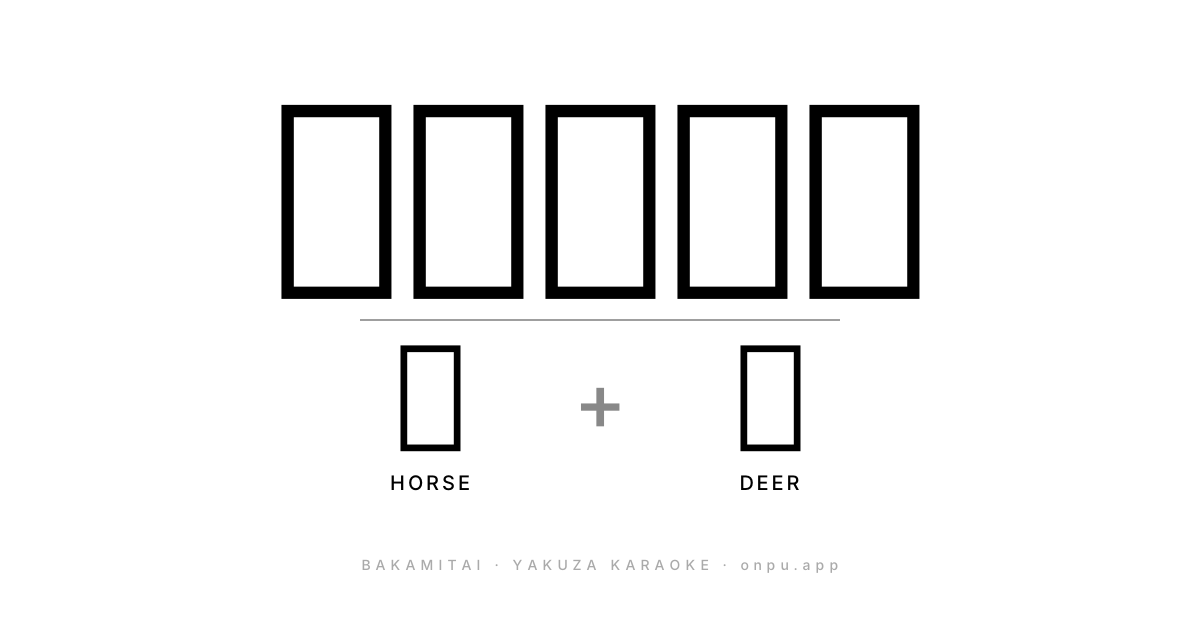
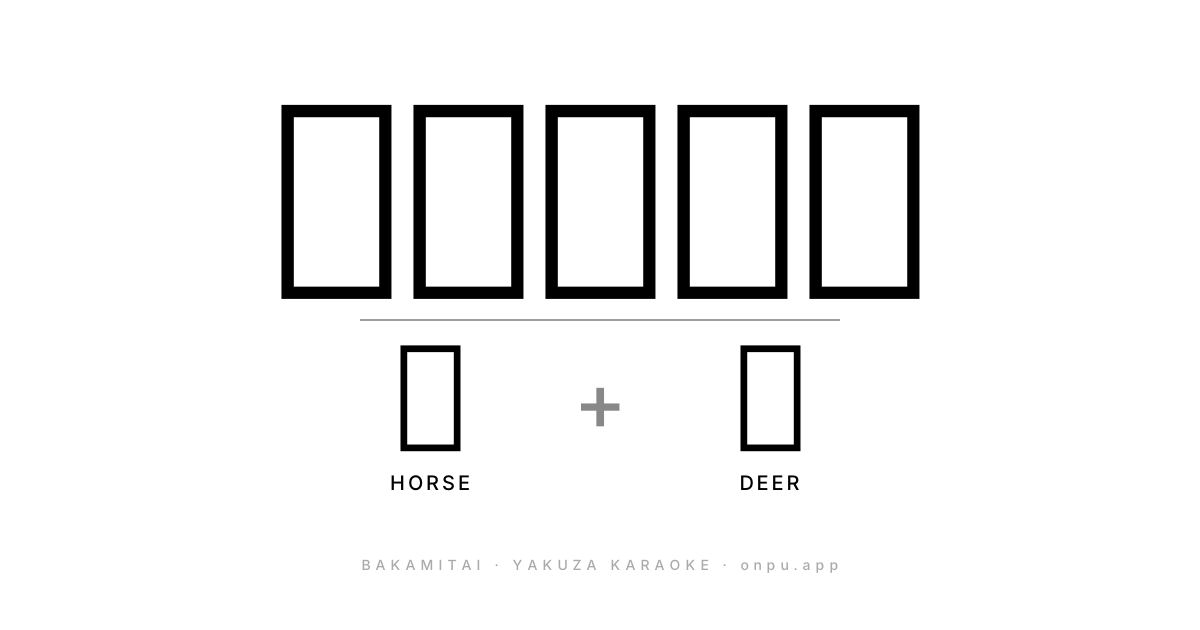
- What the title kanji 馬鹿 are made of (two animals you already know)
- Why ばかみたい does not mean "I am a fool" the way you probably read it
The song is sung by men. The grammar is not.
Japanese has sentence-final particles that carry gender signal. They are not pronouns. They are little tags at the end of a thought that say something about who is speaking. Some are neutral. Some are masculine. Some are feminine. Native speakers hear them the same way you hear "darling" versus "bro" in English.
Bakamitai is full of the feminine ones. Stacked, line after line.
The first time you really notice is the chorus:
だめだね だめよ だめなのよ
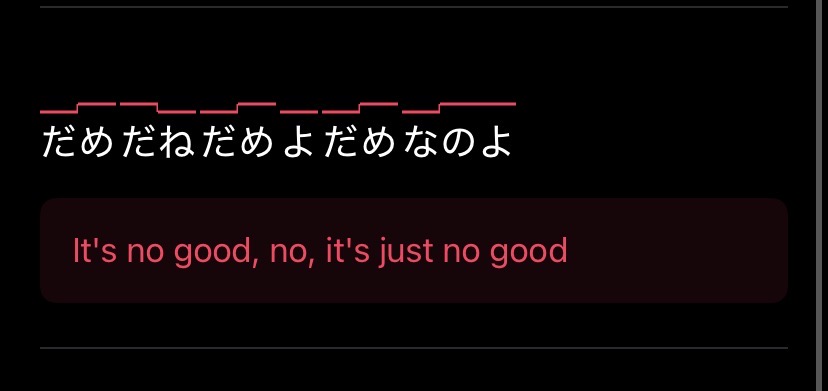
That のよ is the one. It is a feminine sentence-ender that softens a statement into something almost confessional. A man would more likely land on だめだ or だめだよ. The のよ marks the speaker as female, and the line repeats it three times the way a heartbroken person rehearses the same thought until it sticks.
Two verses later, after she takes the rings off:
ざまあみろ せいせいするわ
The わ at the end is the one to watch. In standard Japanese, わ as a sentence-ender is strongly feminine. It is the kind of marker that makes a line read as a woman's thought without the writer ever having to say so.
And then near the end, the line that always gets me:
なんなのよ この涙 馬鹿みたい
What is this, these tears, like a fool. The のよ is back, paired with あんた earlier in the song. あんた is an informal "you" that, said by a woman to a man she loves and is angry at, lands somewhere between "honey" and "you idiot."
Three verified lines, three different feminine particles, the same speaker. None of this is in the melody. All of it is in the grammar that Kiryu, deadpan, sings on top.
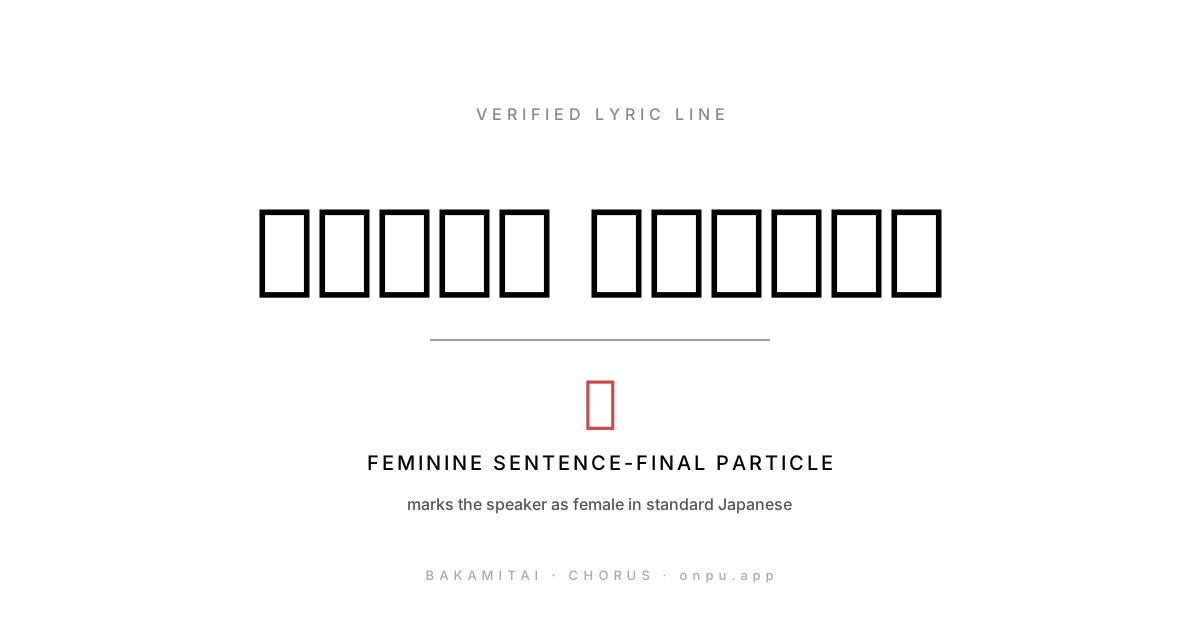
If you take one thing from this section into your next J-pop listen, listen for the わ at the end of a line, especially in older ballads. It is one of the cleanest signals that the lyric is voiced as a woman, even when the singer is not.
She is not from Tokyo, and the song says it twice.
Once you notice who is speaking, the next thing is where she is from.
Bakamitai is written in Kansai dialect. Kansai is the region around Osaka and Kyoto, with its own grammar and its own little words that signal "I am from there." Standard Tokyo Japanese has 本当に (really, truly). Kansai has ほんまに. Standard Tokyo has じゃない (is not). Kansai has やない.
Bakamitai uses both. Verified.
口下手でほんまに不器用
Bad with words, really clumsy. That ほんまに is Kansai. The standard Tokyo line would have used 本当に and it would not have hit the same. ほんまに has a softer, more rural shape on the tongue.
ほんまに ロクな男やない
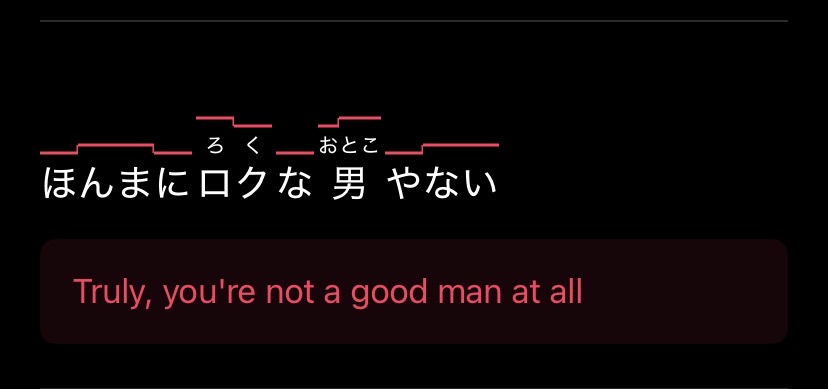
Really, you are no good of a man. That やない at the end is Kansai for じゃない. Two Kansai markers in one line. The song is telling you the woman is from Kansai and she is calling her man worthless in the grammar of her hometown.
I want to be careful here, because it would be easy to write a sentence that says "Kansai dialect makes the song sound feminine." It does not. The Kansai is doing one job. The のよ and わ and あんた are doing a different one. The femininity comes from the particles. The regional warmth comes from the dialect. Stacked, but separate.
If you paste a Kansai-written song into a translator, the gender-neutral English will erase both signals at once. The translation will say "I'm such a fool" and you will read it as if it could be anybody. The Japanese is much more specific than that.
The title is two animals.
If you have only ever seen ばかみたい in hiragana on the Yakuza karaoke screen, you might not know that the kanji form is hiding something funny.
馬鹿. Two kanji.
馬 is N3 in JLPT terms. It means horse. You probably know it from 競馬 (horse racing).
鹿 is N1, a bit later in most learning paths. It means deer. You see it in 鹿児島 (Kagoshima) and on the road signs in Nara, the city full of bowing deer.
馬 + 鹿 = fool.
Two perfectly innocent animals slammed together to mean idiot. Onpu shows you this the moment you long-press the kanji in a Bakamitai lyric line. Horse. Deer. Fool. There is a folk etymology about a Chinese minister pointing at a deer and calling it a horse to test loyalty, but Japanese dictionaries are not unanimous on whether that is the real origin, so I am leaving it as "interesting story, debated source." The visual fact is what is real: 馬鹿 is two animals you already know, sitting next to each other.
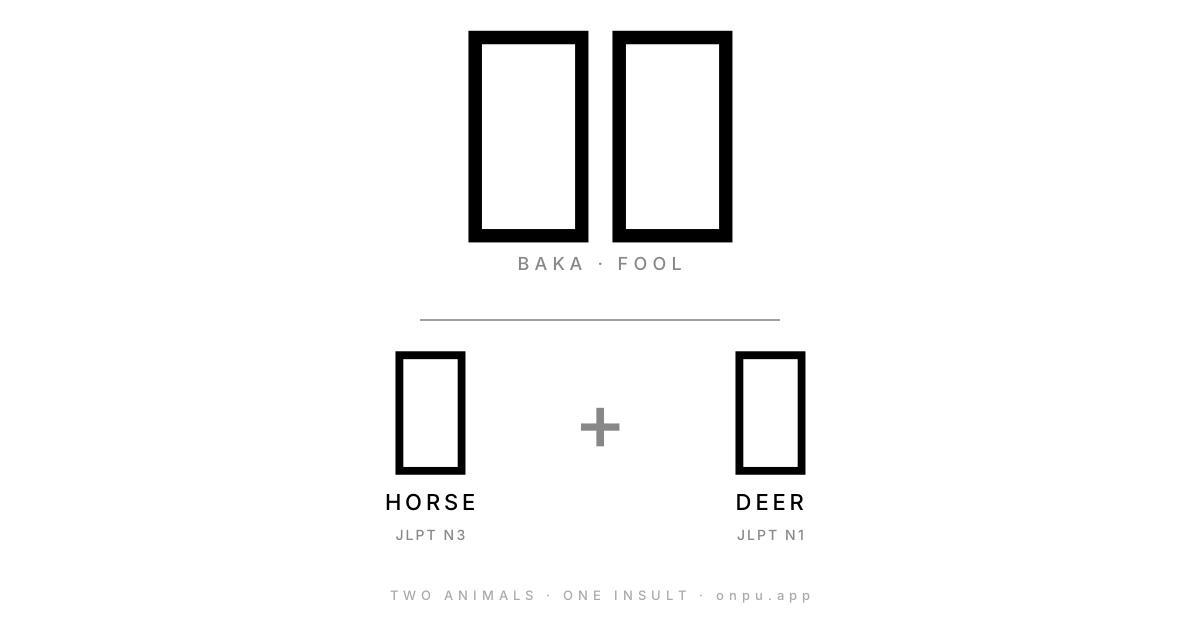
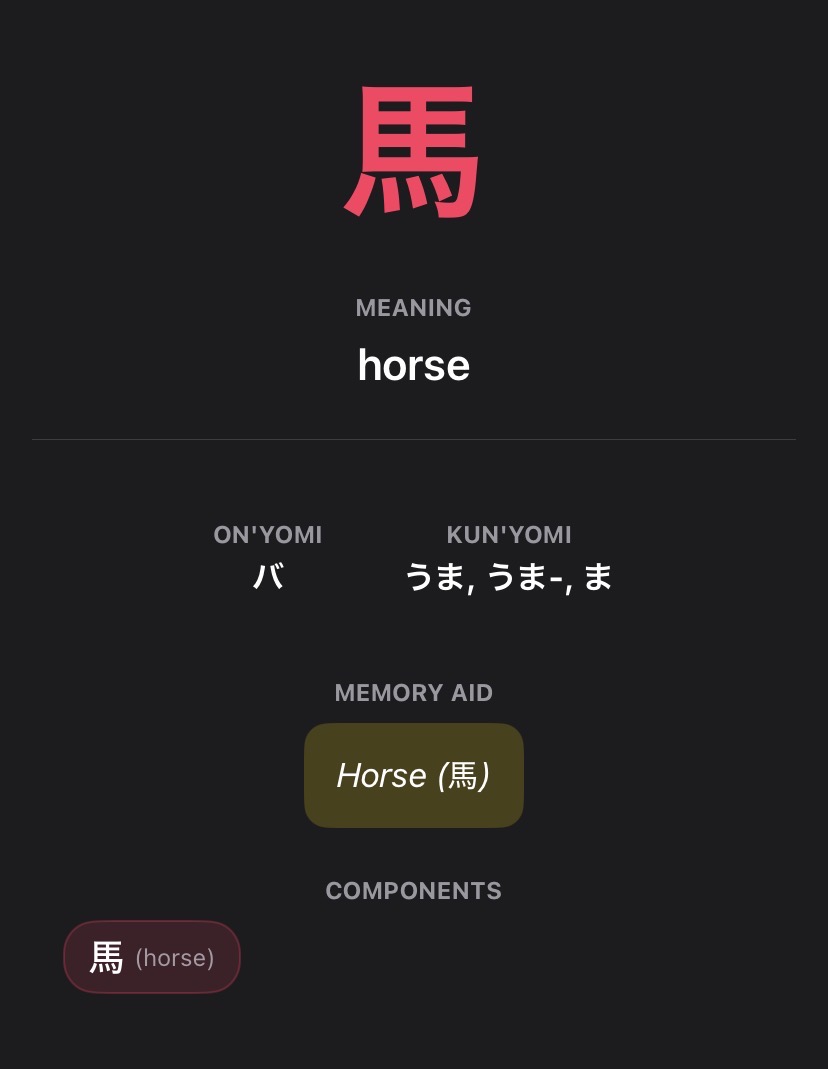
The karaoke screen renders the title as ばかみたい, all hiragana, soft and small. The lyric sheet uses 馬鹿. Both pronounce the same way. The hiragana version feels childlike, even tender. The kanji version feels pointed, the way insults do when written down.
Other songs play this same surface-vs-substance game. Yorushika built an entire song around two kanji that sound exactly the same, and Porno Graffitti named one of theirs after a Portuguese word that does not have a clean Japanese translation. Bakamitai does it with two animals.
What "ばかみたい" actually means coming from her mouth
Here is the part I had completely backward for a while.
I had been hearing "ばかみたい" as "I am a fool." That is wrong, and it changes the song.
みたい is a Japanese ending that means "looks like" or "seems like." Not "is." 馬鹿みたい translates closer to "looks foolish" or "seems like a fool." It is what you say when you watch yourself from outside and do not love what you see.
That is why the line at the end of the song hits:
なんなのよ この涙 馬鹿みたい
What is this, this crying. Looks foolish. She is not condemning herself directly. She is watching herself cry over a man who is no good and saying, from outside, that the scene looks ridiculous. That is a more specific feeling than self-loathing. It is the feeling of catching your own reflection mid-cry and feeling a small, weary embarrassment at the version of yourself you are seeing.
The whole song is in that voice. She is past the heartbreak enough to look back and call it foolish, while still crying. Both at once. A flat translation cannot carry that. "I'm such a fool" loses the みたい. The grammar is the feeling.
Try it on your next listen
If you put Bakamitai on at karaoke this week or hit it in your next Yakuza playthrough, do me one favor. Open the lyrics in Onpu and watch what shows up at the end of each line.
The のよ. The わ. The あんた. The ほんまに. Once you see them in the line-by-line view, the song sounds different the next time the chorus comes around. A man's voice on a woman's grammar from a region nobody in the cast was born in. The gap is the entire emotional engine.
The kanji breakdown for 馬鹿 is in there too. Long-press either character. Horse. Deer. Fool.
If you also have Pararirai unlocked from Kiwami 3, paste that one in too. Half the karaoke tracks are doing more language work than the gameplay lets on. I would love to know which ones surprised you.